Business before pleasure, and it may be remembered that some weeks ago I entered into conversation with a Dee Stephens at Natural England who assured me that she would investigate some of the accusations I have leveled at the RSPB here in Weymouth. Ms Stephens is not the easiest person to get hold of, and as I don't leave messages it was only this afternoon that I was able to talk to her. After a short while and a little prompting she did remember who I was, and began by saying that she had spoken to Nick Tomlinson (RSPB Reserves Manager) on the phone and then, sounding a little unsure, went on to say she had paid a site visit to Radipole. On the subject of the Sand Martin Wall she said "it looked alright to me", and I countered by saying "it looks alright to me as well, and will look even better next year when it's full of Sand Martins". However, it is the 'time of build' that concerns myself and many others, to which she would only venture "yes, it could have been built at a better time". She went on to say that Mr Tomlinson had assured her that a survey of the proposed building site had been undertaken which had found nothing there to disturb. Personally, I still maintain with him ploughing through the reed-beds in his size 12's there wasn't likely to be, while during the early April period who knows what did or could have dropped in between survey and commencement of building????
On the subject of the 'Great Fire' she used the word 'UNFORTUNATE', for the first but not the last time. I suppose that just about sums it up when someone enters a tinder dry reed-bed on a 'windy' day, burns untold acreage 'killing' god knows what in the process, necessitating the attendance of 17 fire appliances, police helicopter, waterborne division and a cost to the 'tax payer' of a reputed £250,000, yes that is unfortunate Ms Stephens.
Without satisfaction on my part, we'd now arrived at the 'grubbing out' of the well established colony of Southern Marsh Orchids, where she was quick to say that Mr Tomlinson did admit he had destroyed just 'half a dozen' during the refurbishment of the dikes. Why then didn't he admit this to me when we met at my house. Her opinion of this was - wait for it - "UNFORTUNATE", but she did go on to give a little solace. "There are plenty of these all over the reserve, and anyway they are not protected (named) under the schedule designed for an SSSI". I told her they were the exact words used by Nick Quintrell when I presented him with 3 flowering stems of Bee Orchid he had just 'strimmed to death' last year, but she simply went on to repeat herself! I was now getting angry, and pride myself as I do for never being rude to people, I politely finished the conversation by saying "that's what they said about the Passenger Pigeon and Dodo" said my goodbye, and hung up.
Where do they get these people? What qualification do they have to be guardians of our wildlife and beautiful lands? I republish here Nick Tomlinson's assessment of himself on the Out & About forum dated 9th April 2010:-
Whilst I freely accept that many, probably nearly all, of those on this forum have a far greater knowledge of birds and birding than I do, I pride myself that I have at least a moderate understanding of issues relating to how to manage a nature reserve and, where my knowledge fails, I have access to a very much wider pool of knowledge and experience within the RSPB. The decisions we take are, therefore, taken with the best available information.
It is proving MODERATE coupled with 'assured backup' is not enough, proportionately what is happening to our reserves is comparable to the Gulf of Mexico!
It is proving MODERATE coupled with 'assured backup' is not enough, proportionately what is happening to our reserves is comparable to the Gulf of Mexico!
anyway, on a lighter note:-
This morning was once again overcast but what little wind there was had veered to the west, the drizzle had gone so the day was perfect for bird and wildlife watching.
The cemetery was literally quiet as the grave, with hardly a bird song let alone anything else, but at Radipole over 100 each of House and Sand Martin filled the air. What I always consider an excellent sight are the 'less common' breeding ducks with young, and this morning was the turn of Tufted with a brood of c5 youngsters. Hardly the size if a golf ball, they were already able to feed themselves, with some dives I timed reaching 30 seconds. The only other record of note were c3 Common Terns feeding at the eastern edge of the lake, so I quickly walked on to Lodmoor. There, the Common Tern colony is still going great guns and with just the aid of binoculars and at a distance I was still able to count 51 young birds. Of these a number are close to fledging, while parent birds are occupied between feeding them and warding off predators - one juvenile Grey Heron learnt a lesson this morning it may never forget?
This morning was once again overcast but what little wind there was had veered to the west, the drizzle had gone so the day was perfect for bird and wildlife watching.
The cemetery was literally quiet as the grave, with hardly a bird song let alone anything else, but at Radipole over 100 each of House and Sand Martin filled the air. What I always consider an excellent sight are the 'less common' breeding ducks with young, and this morning was the turn of Tufted with a brood of c5 youngsters. Hardly the size if a golf ball, they were already able to feed themselves, with some dives I timed reaching 30 seconds. The only other record of note were c3 Common Terns feeding at the eastern edge of the lake, so I quickly walked on to Lodmoor. There, the Common Tern colony is still going great guns and with just the aid of binoculars and at a distance I was still able to count 51 young birds. Of these a number are close to fledging, while parent birds are occupied between feeding them and warding off predators - one juvenile Grey Heron learnt a lesson this morning it may never forget?
 It is possible that this variety of Bee Orchid (fulvofusca) exists nowhere else in the British Isles and is the second such, along with a specimen of the equally rare atrofuscus found at this site in the last few days. It is mind boggling to think that the RSPB 'strimmed' this very spot not once, but twice by this time last year.
 Just a couple of days on and the Buddleia is now in full bloom.
 Ragwort (the the yellow one) scourge of livestock everywhere.
 It is not unusual to see farmer, horse owners etc hand pulling this weed from fields as harmful to their animals.
 Take no notice of the 'Early Enquiries' notice on this block of luxury flats close to Lodmoor, as it seems building has been suspended as the developer has run out of money. Some say they could remain like this for 2 years!
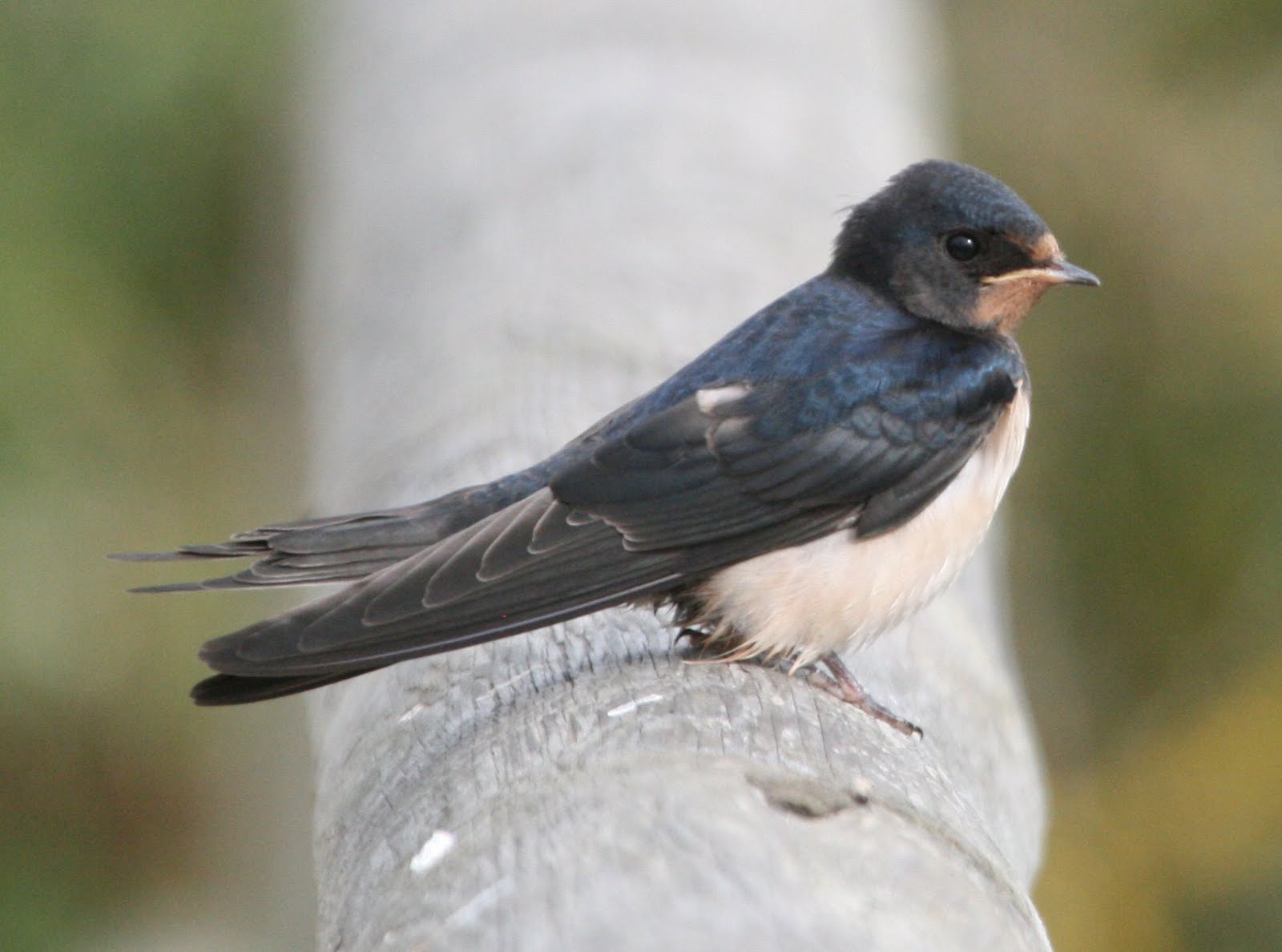 A young Swallow takes a rest at Lodmoor before the long fly south.
As the tide is low throughout most of the morning during this phase of the moon, it's always worth a look at Ferry Bridge. Unfortunately not that long sought after rarity today but a single Little Egret was in attendance, plus c6 Ringed Plover while unusually these
 Little Terns (c17 at that time) were perched on the sand at the 'low water mark' preening, while a group of c18 Dunlin fed close by.
 Front
Front Back
Back and Side
 a family of juvenile Starlings were also making the most of the now sunny weather, as
 a parent bird looked on.
At Portland I just did a circuit of the Top Fields, where c2 of the recently fledged Peregrines were honing their flying skills while screeching at the top of their voices, while this young
 Blue Tit struck a pose at Culverwell.
Martin Cade, the Warden at the Portland Bird Observatory, kindly produced this most striking
 Convolvulus Hawk-moth, while in the fields east of the Lighthouse these
 Pyramidal Orchids were in fine bloom.
and finally:-
While sitting here typing up today's post, there was an unholy row coming from the ever present Herring Gulls flying around my house, a real bonus in some circumstances as they often alert me to a passing 'bird of prey'. Surely a Honey Buzzard or Montagu's Harrier, but no, the following images show a hapless young Herring Gull away from the protective gaze of the parent birds, being attacked by another adult.
 Initially perching on a neighbour's roof, it was forced forward off the ridge tiles,
 then dragged backed allowing more purchase.
 Then, standing on the youngster's back the attacker delivered a few blows with its bill,
 before it fell over the apex looking mortally wounded. I can only think this was in desperation for food, but guess it could have been a family feud?


