Tuesday, 3 August 2010

Seychelles to Kazakhstan - Sudan to Jamaica

Thinking I wouldn't be out too long today, I had even put my rain jacket on but within the hour the rain bearing clouds had dissipated, the sun was out and all was well with the world. Apart from a brief spell walking the west cliff at Portland where the wind had veered almost to the north west and became a little chilly it was an excellent day weather wise.

On the way to Radipole I once again tested the cherry plums, which are now sweet, plump and ready for picking, and noted that quite a few Warblers were in evidence Reed, Sedge, Willow and Cetti's. Not a lot else until I was about to leave and the call of a Wood Sandpiper drew my attention. It landed briefly on the island close to the visitor's center but with little there for any Wader it flew off in the direction of Lodmoor.

Wood Sandpiper (archive)

The walk along the Esplanade (to Lodmoor) produced a few Common Terns, but otherwise just this Cruise Ship of the Holland America Line named MV Westerdam. That was something I would have had to have looked up on the Internet (my binoculars not being powerful enough to pick out the full name) if my mate Roy Henderson hadn't text me knowing I would be most interested.

On the Moor I was soon joined by Daragh Croxson and Dick Morris and set of in search of something rare. Unfortunately, that was not to be but single Sparrowhawk and Common Buzzard were both perch on fence posts as we watched the now depleting Common Tern colony including the remaining few juvenile birds. In addition there were also c14 Dunlin, probably as many as 3 Common Sandpiper, a good number of Lapwing, which remained uncounted, c2 summer plumage Black-tailed Godwit and what was thought to be the first Common Snipe for this end of the year?

As an aside, Dick mentioned the 'post' including Roy Wood and told us that his wife Debbie comes from Repton and by coincidence readers will see a 'Comment' on the same 'post' from James Lidster who studied at the prestigious school there.

At Ferry Bridge there were just c3

Turnstone (of note) all with quite strikingly different plumage.

Turnstone 2

Turnstone 3

He and I at his 65th birthday dinner.

On my way to the bus John 'Sooty' Stockley pull off the road for a bit of a chat, so that took care of another hour of the day, but there are few I'd rather bump into.

Portland Bill was depleat of birds by the time I arrived around noon, save for a few departing Swifts, but it's always good to drop into the Observatory for a chat (today with the Warden and bird 'ringer' Ian Dodd) and a coffee,

while on my way to catch the bus, I came across this sign stuck on the back of a van. 'Say no more'!

drill down10.05%SudanSudan
drill down10.05%SwedenSweden
drill down10.05%JamaicaJamaica
drill down10.05%Czech RepublicCzech Republic
drill down10.05%SeychellesSeychelles
drill down10.05%GermanyGermany
drill down10.05%BelarusBelarus
drill down10.05%PolandPoland

It can be seen from today's Stat Counter, that Sudan, Jamaica and today Seychelles has brought the countries tally up to 82. Welcome to you all, and please pass the Blog link to ALL of your friends no matter where they live. Thank you very much - Bagsy.

KEEP THE READERSHIP ALIVE and WORLDWIDE!

Yesterdays sensational Relict Gull is copied here once again to give credit to the lovely lady who sent it to Svetlana, her dear friend Dinara Muratova who lives in Almaty, Kazakhstan. It was taken in her home country on a Birding Tour which she was guiding recently.


and to close, I have had a few more e-mails from Svetlana Ashby who, among other things, sent this excellent photograph of a

Red-legged Kittiwake taken on a recent Kamchatka & Commanders Islands Tour by Svetlana herself.

for further information of these and other exciting bird tours, log on to:-

http://www.kazakhstanbirdtours.com/

Monday, 2 August 2010

RSPB Meeting Part II

This superb Relict Gull is what met me soon after I got up this morning, but not from the bedroom window unfortunately. The small numbers in the world are confined to such countries as China, Mongolia, South Korea and like this one Kazakhstan. I received this image from Doctor Svetlana Ashby who, regular readers may remember, said she would investigate their status at traditional sites. Her friend in Kazakhstan has been keeping her posted, but the news doesn't seem good as this was the only one recorded on a recent bird trip. It was said to be confiding but guess that isn't unusual given in general they rarely see human beings. My interest is to continue, and hopefully complete, my age old ambition to see all 54 of the Gull species in the world. I have just 3 to complete the set if you like, This one, Yellow-footed Gull (found mainly in north west Mexico / California Baja) and Red-legged Kittiwake which will require a visit to the Pribilof Islands located between Alaska and Russia.

Thank you very much Svet for this help, I'll certainly be giving this trip more than a passing thought next spring. If you are interested in such a venture log on to kazakhstan bird tours.

Later in the morning I had a wander around, with weather set fair but birds thin on the ground. Ferry Bridge produced a handful of Dunlin, c3 Sanderling, a juvenile Yellow-legged Gull plus c2 Mediterranean Gulls. With just a single Chiffchaff in the notebook by the time I reached the seaward end of Barleycrates Lane, it was good to look back to see well over 100 House Martins congregating on the cliff edge flats. There were a few Sand Martins and Swallows passing overhead, but the most interesting aspect of the walk thus far was the construction work going on at

Blacknor Fort.

Looks like it might be a Mediterranean style hotel, but Martin Cade (Warden PBO) did suggest there had been some interest from a TV station to make a programme about upmarket gevelopement?

This Skylark was so obliging it seemed to be saying "please take a shot", but a little further on awaited the bird of the day. From the thigh high grass a Grasshopper Warbler popped up a flew to a nearby hedge where I was able just to catch a couple of fleeting glimpses.

In addition there were c2 Wheatears all of which points to a start in the migration south for some early leavers.

At the Observatory Martin pointed out Common Darter a new arrival / emergance since my last visit.

This pair looked to be copulating and egg-laying at the same time

as this pair of Wall Butterflies (my first record this year) were doing similarly.

Finally, this Linnet one of good numbers this year was seen with a 'charm' of Goldfinches.

Returning to the Findings of my meeting with the RSPB

Time was running out as John Snellin had to be elsewhere, so I asked if I could "touch briefly on the Great Fire of Radipole". This brought a litle chuckle from all 3, but Dante looked as though he'd rather the subject not be broached. I asked him if he had made his own investigations, to which he said he had. Further, do the RSPB have a proper system of 'risk assesment' in place and was one completed before the burning operation took place? Yes was the reply on both counts. I then asked him how he would describle the weather conditions on that day, and he replied with the single word 'blustery'. To make it quite clear, tthis is he dictionary definition; "a strong wind - gale [c15: probably from Middle Low German 'blusteren' to storm, blow violently]. So, if this was the assesment of the RSPB Dorset Manager, then surely the Reserve Manager's should be somewhere close to this? From my own limited , but very close experience of this particular document, over 20 years on a North Sea Oil Platform, it is a Heath and Safety Executive requirement that copies be retained for a given number of years. As Dante stated from the onset, this meeting was called, in part, to show the Societies 'transparncy' so maybe he can send a copy for both past and present RSPB supporters to view, in company with the other answers he has promised to send to me? Either way, even considering the wind conditions to be 'blustery' someone was allowed into a tinder dry reed-bed on a Site of Special Scientific Interest with a box of matches - it beggers belief!

In addition, he went on to say that both the Fire Service and Police Force had been informed of the RSPB intent to start a fire in the reed-bed, both giving their blessing. I find this a little hard to believe, but it's not impossible, but this agreement should be noted (logged) somewhere which I intend to investigate in the near future. It may also be of interest to note that the Dorset Echo report a couple of days later quotes Nick Tomlinson as saying "the fire was caused by a 'freak' gust of wind".

And finally, I asked Dante about the timing of the build of the Sand Martin Wall which it transpired wasn't as Nick Tomlinson told me in my home "all his decision" which in my view further tarnishes his reputation. He did however say that he had undertaken a survey, but I am at a loss as to know how anybody can say with conviction that no birds were nesting (or prospecting) the area around the build site. I have asked Dante to write and explain what survey proceedure or technique was used. It was also daunting that the members present were only concerned with birds actually 'nesting' as this is the letter of the law as far as the 1981 Wildlife and Countryside Act goes, but surely their skills in wildlife management would extend concerns to any creature prospecting that area at that sensative time of year.

I know I said finally, but do have to reveil that Dante also admitted to me (and the others present) that he has put an embargo on any local RSPB staff talking to me, or as he put it "engaging" with me. I feel sure somebodies rights are being infringed here, whether that be mine, those of his staff or both but certainly another area worth looking into?

Sunday, 1 August 2010

Black Tot Day - 31/07/1970

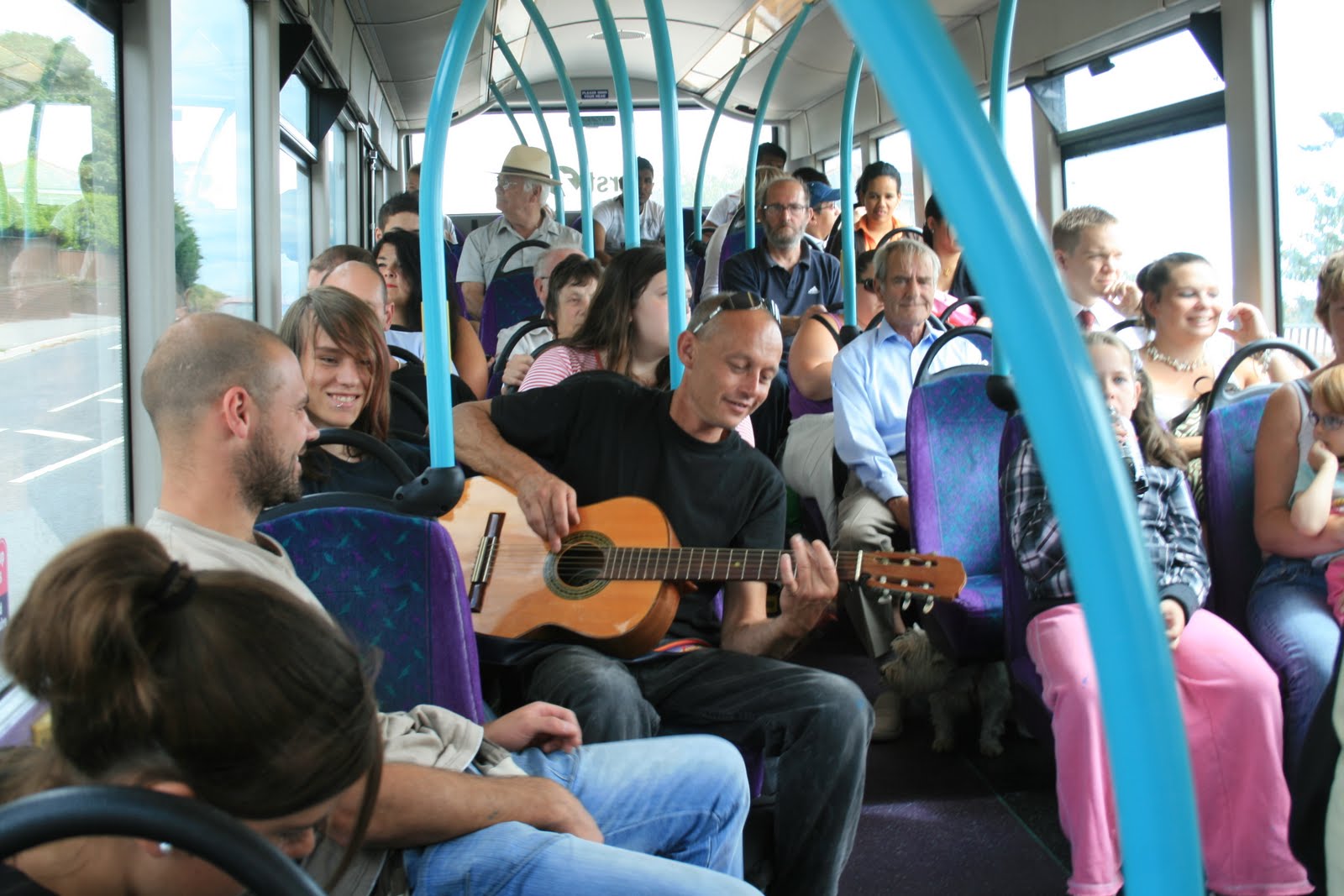
My 'run ashore' yesterday started long before I arrived at the Corner House Inn, Easton, Portland, as I boarded the bus to find a rock concert in full swing, well not quite, and I don't think Dave Gilmour was particularly perturbed by the guy in the pictures playing. Not for the first time was I mistaken for blues legend Peter Green, founder of the seminal band Fleetwood Mac, and as has happened in the past there is little chance of convincing people otherwise once their mind is made up. However, joining in on vocals, and a change of axeman (the lad with the shaved head) we sang our way through Shine On You Crazy Diamond, Wish You Were Here and Time, the lyrics of which have probably influenced me more than any others.
Don't Miss the Starting Gun


Time
(Mason, Waters, Wright, Gilmour)


Ticking away the moments that make up a dull day
You fritter and waste the hours in an offhand way.
Kicking around on a piece of ground in your home town
Waiting for someone or something to show you the way.

Tired of lying in the sunshine staying home to watch the rain.
You are young and life is long and there is time to kill today.
And then one day you find ten years have got behind you.
No one told you when to run, you missed the starting gun.

So you run and you run to catch up with the sun but it's sinking
Racing around to come up behind you again.
The sun is the same in a relative way but you're older,
Shorter of breath and one day closer to death.

Every year is getting shorter never seem to find the time.
Plans that either come to naught or half a page of scribbled lines
Hanging on in quiet desperation is the English way
The time is gone, the song is over,
Thought I'd something more to say.

This part of the Post is dedicated to Ginge & Val Prince and Robbie ex Chief TASI who unfortunately couldn't make it yesterday. I had a 'sipper' for each of you!

Serving rum to a sailor from a tub inscribed 'THE KING GOD BLESS HIM'

Up Spirits

The myths, legends, dits (sailor's stories) and general romance of the Royal Naval Rum Ration are endless and certainly too long for this Blog, but with it came a new language, passed down through the ages, sense of community and comradeship which one day I intend to write in full. I only went in the 'rattle' (trouble) once as a result of drinking Pusser's (everything RN belongs to Pusser) Bubbly (rum). I can still hear the words of ex-shipmate Dixie Dean echoing across Chatham Dockyard as we met for the first time in several years, with his right hand raised high above his head, fist clenched with outboard fingers stretched (what is described today by the Heavy metal Fraternity as The Devil's Horns) representing a measure of rum and shouting "Bagsy, come round (visit my ship at 'tot time') I'm on the Abdial". Such an invitation, steeped in tradition and ceremony, inevitably led to an intoxicated state as the hospitality shown to any visitor meant each 'G member' (a Rating or Senior Rate, Petty Officer or Chief Petty Officer, over the age of 20 who had opted to 'draw' a tot) would after following the correct protocol offer some of his 'grog' to the guest.

Naval Rum


Rum's association with piracy began with English privateers trading on the valuable commodity. As some of the privateers became pirates and buccaneers, their fondness for rum remained, the association between the two only being strengthened by literary works such as Robert Louis Stevenson's Treasure Island.

The association of rum with the Royal Navy began in 1655 when the British fleet captured the island of Jamaica. With the availability of domestically produced rum, the British changed the daily ration of liquor given to seamen from French brandy to rum. While the ration was originally given neat, or mixed with lime juice, the practice of watering down the rum began around 1740. To help minimize the effect of the alcohol on his sailors, Admiral Edward Vernon directed that the rum ration be watered down before being issued, a mixture which became known as grog. While it is widely believed that the term grog was coined at this time in honor of the grogram cloak Admiral Vernon wore in rough weather, the term has been demonstrated to predate his famous orders, with probable origins in the West Indies, perhaps of African etymology. The Royal Navy continued to give its sailors a daily rum ration, known as a "tot," until the practice was abolished after July 31, 1970. Today the rum ration (tot) is still issued on special occasions by H.M. Queen Elizabeth II order "Splice the mainbrace"! Such recent occasions have been Royal marriages/Birthdays, special anniversaries. Splice the main brace (splicers) in the days of the daily ration meant double rations that day.

A story involving naval rum is that following his victory at the Battle of Trafalgar, Horatio Nelson's body was preserved in a cask of rum to allow transport back to England. Upon arrival, however, the cask was opened and found to be empty of rum. The pickled body was removed and, upon inspection, it was discovered that the sailors had drilled a hole in the bottom of the cask and drunk all the rum, in the process drinking Nelson's blood. Thus, this tale serves as a basis for the term Nelson's Blood being used to describe rum. It also serves as the basis for the term "Tapping the Admiral" being used to describe drinking the daily rum ration. The details of the story are disputed, as many historians claim the cask contained French brandy whilst others claim instead the term originated from a toast to Admiral Nelson. Variations of the story, involving different notable corpses, have been in circulation for many years.

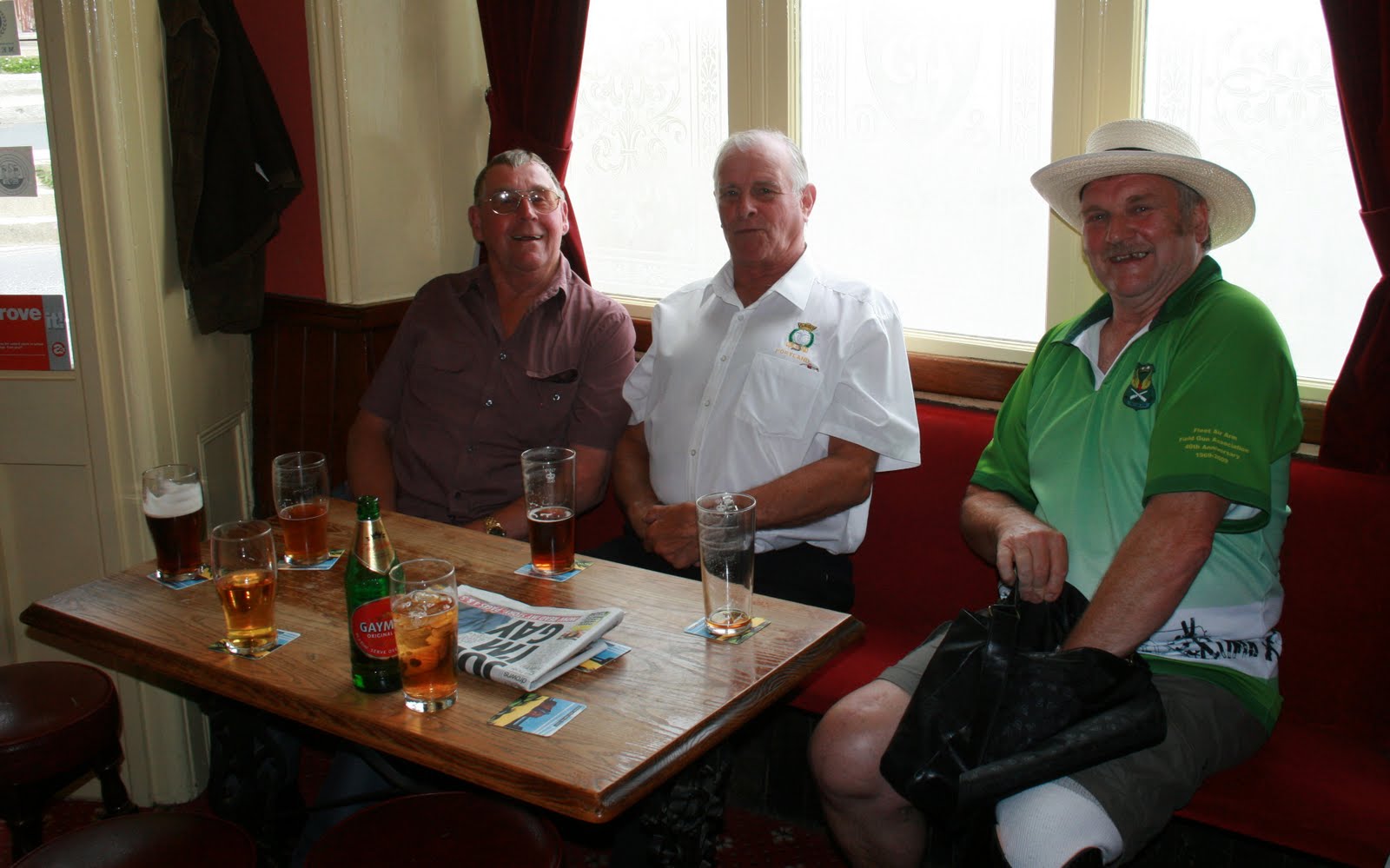
Arriving at the Corner House Inn to celebrate 40 years of the 'passing' of the tot.

Each mess-deck table, at the appointed hour, would look similar to this (minus the flag) with the Rum Fanny centrally placed, tumblers at hand and a measure to issue each man with the right amount, with a small exception! Of course there was no price to pay onboard, but this was a fine charity event in aid of Help the Hero's and the Royal National Lifeboat Institute.

The 'Rum Rats' (a man who is particularly fond of his, and any others he can get, tot) muster. Dennis Matthews, 'Tansy' Lee & Roger Fulbrook await the call to 'scupper their bubs' (drink their rum, a scupper being a drain onboard ship). I can report that Roger went home legless, and spent part of the afternoon passing his prossthesis between his shipmates, RN high jinx at their very best.

Shipmate John Keegan and his wife Jenny (right)

Jim Holt & Arthur Copus. The last time I saw Jim must have been 2 decades ago, but he remembered the moment perfectly. Having both been members of the Chief Petty Officers Mess at the Portland shore-base HMS Osprey, I had called in for a lunchtime pint and met up with Jim and his wife. He reminded me that I had, that morning, caught what was then a fairly scarce moth called a Portland Ribbon Wave, they had both remembered its name as well - impressive.

As for Arthur, I had never met him before but it was indeed a pleasure, was the last First Lieutenant of HMS Osprey.

I am the proud owner of these lead sailors forming the 'Last Colour Guard' at the closing ceremony of HMS Osprey, a gift from the Stockley family on my 50th birthday, I'm sure Arthur will remember this with pride.

Jan (the Viking) Farley who I have known for 39 years and until his wife mentioned it yesterday had no idea his name was Kieth.

Many 'orders' onboard ship are passed by both Bosun's Call (whistle) and Bugle, yesterday a Chief Petty Officer Gunnery Instructor from the local Cadet Force called 'hands of messes for rum' - we all heard that OK!

Landlord Jeff Chitty became Bubbly (rum) Bosun for the day, ably assisted by Ticker Off (seeing each man gets his measure) Andy Porter. In time honoured tradition, each man 'drawing' his tot would, as the tumbler were offered, say to the Bosun "have a whet" (no more than a sip of the nectar) the glass would then be passed to the recipient. In turn he would hand it to the Ticker Off making the same offer, after which he would allow any 'guest in the mess' the amount he would decide. This could be a 'sipper', as described above as a 'whet', a 'gulper' a small mouthful, 'half a tot' self explanatory or 'sandy bottoms' with the words "see it off". The exception to the full measure, as described above, comes as the Bosun first fills a tumbler, then the measure decanting the glassful into the measure but being sure to have 2 fingers inside the measure allowing more ullage to return to the 'rum fanny'. There would already have been a small degree of spillage when the rum was collected from the barrel, show above, and together this left over amount would be known as (Kings) or 'Queens'. Legally, this rum belongs to the Monarch and should by rights be 'ditched', but your average Matelot (particularly rum rat) hates waste and would argue that Her Majesty wouldn't want it anyway. So, this would be put into another tumbler and passed around the G Members who remain around the table until it is gone.

While G stands for Grog the alternative is T equalling Teetotal, attracting a small financial payment, and as the reader can probably imagine there weren't many of these. Rum is collateral for a number of favours, with in the early days you could get your dhobying (washing cloths), ironing or even get someone to stand you watch so you could go ashore. In addition there are UA's who are too young to draw and RA's, men who when the situation allows live at home and forfeit their tot.

Seniority hold great sway in any mess, and as 'Senior Man Present John Jeffery's was given the honour of being the first to draw his tot.

In General Service (surface ships, establishments etc) and the Fleet Air Arm the regulation 2 part water, one part rum was the norm, however in 'Boats' (Submarines) the mix was one & one, probably by way of compensation for not being able to Bath and Dhoby for weeks on end. I was sure to wear my 'Dolphins' (the insignia broach of the service) just in case.

It was fantastic to see Terry & Isobel Wye as he was an old school friend of mine. Terry took time to look around in 'civvy street' before joining the RN 5 years after me. I did advise that he would never stick it out, and how right I was, he only managed to put in 33 years!!

The biggest surprise of all was when former 'Club Swinger' (Physical Training Instructor) Chief Petty Officer and British Empire Medal holder Gary Oaks turn up. Gary and I served together in 1964 when he was simple known to me as SIR! and a lot of water under the bridge since that was the last time we met.

Jeff then ran an auction for 2 excellent prizes, this a watercolour of an uncertain warship,

and this a bottle of Walter Hicks Navy Rum. Both fetched around £60 and in typical Mess Mate fashion Roger Fulbrook opened the rum sharing it with the Crew.

There were some tears when the tot was finally stopped on 31/07/1970, 40 years to the day of this gathering. Lady Astor had tried to stop it many years earlier, a staunch absainist, accusing Sir Winston Churchill of being drunk in Parliament. His reply was reputed to be "yes madam, I am drunk and you are ugly but I'll be sober in the morning". I'm sure everyone has their own memories of that day, but for me it was a tot onboardHM Submarine Porpoise, on which I was the Scratcher (Bosun) fefiting in a drydock in Portsmouth Harbour. On completion most of the crew took a fast boat ride to HMS Dolphin the Submarine Base in Gosport and joined the lads on the Finwhal for that final dram, smashing our glasses on the ballast tanks as a final salute. The Lament above was issued a couple of days later.
Right clicking on the image will magnify it.

As if to cap the whole event, I returned to the Corner House at noon today to thank all concerned with a box of chocolates and a disc containing all of the photographs. There I met yet another of my long lost mates Roger (Bungy) Williams former Master at Arms (the Chief of Police as far as the Navy is concerned.
WHAT A WEEK-END
Thanks to Jackie Potts (Bar Staff) plus Jeff & Heather Chitty
and all those who came and gave!
PS - Good Potmess

Saturday, 31 July 2010

RSPB Meeting Part I

I will admit to having been crestfallen yesterday, with no energy to go into detail about my meeting with the RSPB et al but now 'another day, another dollar'!

Early days yet, but I await the answers to a number of questions posed to Dante Munn RSPB and while trying hard not to be negative feel they will, if forthcoming at all, be ineffectual. The first of those questions related to the qualifications and professional 'managerial' attributes of Nick Tomlinson, the Manager of RSPB reserves in Weymouth. Both RSPB and NE responded by saying that prospective candidates are not necessarily selected by certificated credential but an overall feeling of competence for the job. Here I would reiterate Nick Tomlinson's own assessment of himself to the Out & About Forum a Web-site mainly for like-minded 'birders'. "While I freely accept that many, probably nearly all, of those on this forum have a far greater knowledge of birds and birding than I do, I pride myself that I have at least a MODERATE UNDERSTANDING of issues relating to how to manage a nature reserve. It was at this point that John Snellin the Dorset Police Wildlife Officer interjected by informing us that there are members of the Constabulary who have no certificated qualifications. I find this statement a little difficult to believe, but given the crime detection rate it may well follow. Fortunately, I have a dear friend an ex-Chief Inspector who I have spoken to at length reference the post of Wildlife Crime Officer and will look forward to seeking his view on this. Finally on this subject, it should be made clear that Nick does have some experience as he was, for a period of time, the Manager of the RSPB bookshop at Radipole Lake Visitor's Center, but you know I cannot for the life of me clear the word nepotism from the forefront of my mind.

Next on the agenda came Strimming and the destruction of plant life on the Weymouth reserves. I asked why, what seems like the continuous, cutting of the verges is necessary and what purpose it serves, especially as Orchids are being destroyed in the process. John Stobard NE described how he/his organisation write to dissuade various local councils from indiscriminately cutting public roadside verges for the same reason, then went on to say that on the reserves the Orchids will not tolerate much of the high vegetation around them. He disagreed that the process there is indiscriminate and that searches and surveys are carried out before proceeding. Why then was I able to produce 3 stalks of Bee Orchid to Nick Quintrell the reserves Warden last year which he or his cohorts had chopped down. John also disagreed that the colony of Lizard Orchids close to Farmer Palmers at Wareham was destroyed by strimming, as he quite rightly said colonies do die of natural causes. However, it is a fact that the council did cut these verges over a number of years, never allowing these plants to attain maturity which undoubtedly could have contributed to the destruction of yet another fragile site. Personal replies from councils have informed me that verge cutting goes to tender and is done on a rotational basis and pinpoint timing is not cost effective.

On the subject of the destruction of the colony of Southern Marsh Orchids during the refurbishment of the dikes at Radipole, both Dante and John NE were in agreement saying "once you let contractors loose there's no knowing what damage they might do". I readily admitted know little, if anything about watercourse and water-flow, but await particularly for Dante's answer to my question as to why the colony had to be grubbed out to provide a spur channel at this exact spot. I still maintain it could just as easily have been dug a few feet either north or south, but my own theories are either RSPB didn't know the Orchids were there, or they simply wanted to remove access to the waters edge to deter anglers. But hey much easier to blame the Contractor!!!

Finally on this subject and what I find most disturbing are some of the statements made about these precious plants. "No need to worry, there are plenty more of those on the reserve" attributed to both Nick Quintrell RSPB Warden and Dee Stevens of Natural England. "It is not a concern (the strimming) as they will grow again" John Stobard NE.

As there is much more to say, but other things to do, I will continue via tomorrows post and continue with far more serious matter

It was about this time that John Snellin once again offered a comment that in most of my submissions thus far the name of Nick Tomlinson recurred time and time again. Not surprising as he is the Manager and singularly responsible for everything that happens on our reserves, but he further claimed that I was making it personal. I had preempted such an inane suggestion might be made, and produced my passport to show Nick as, after my daughter, to be the second point of contact in the event of an emergency, proving how close we have been. This adequately endorsed my dilemma of challenging not only a personal friend but also a friend of my family, and his inability to contain these matters on a one to one basis. The sole reason for continuation of what has been dubbed 'my campaign' stems from the behaviour of Nick, in my house, when he stated "when I decide (and not RSPB higher authority) that the Sand Martin wall will be built in April, it will be built in April" (a position that Dante Munn assured me yesterday was patently untrue) for when I encounter the BIGOT there is no surrender, a point I made to Nick before I required him to leave my house.

I have two comments on your notes of yesterday’s (30th) meeting. Please see below.

RE: Dante did agree to investigate a number of my concerns (well documented in this Blog) and so I await his findings……

Comment: The meeting attendees presumably knew of your specific concerns a long time before the meeting, so to say that ‘they will investigate a number of (your) concerns' suggest to me that they did not plan for the meeting, despite knowing the main agenda items in ample time. Such behaviour would be considered unacceptable in modern business good practice and says a lot about the organisations the attendees represented and suggests that you were onto a loser even before you started.

RE: The final issue discussed was the Little Tern colony at Ferry Bridge, and while I requested to look at the documentation allowing both 'ringing' and 'disturbance' no fewer than 4 times I never did get to read them. I had Paul,

to agree (wholeheartedly) that success at the colony was most welcome, but will at some stage write to The British Trust for Ornithology to confirm that all forms of disturbance (photography particularly) are covered by these documents.

Comment: Naturally I agree with the second part of this paragraph and commend those who contributed to the successful outcome at the colony. Concerning the documentation you wished to see I see no reason why the attendees should not allow you to see the Schedule 1 licence for the Little Tern ringing and/or photography; I can only assume that as any Schedule 1 licence is issued in the name of an individual then the licensee would be in possession of the appropriate documentation and that it would not be immediately available to the meeting. Nevertheless, once again it would appear to indicate a lack of planning on the attendees part. (For your information, any BTO ringer would be required to obtain such a licence before embarking on a Little Tern pullus ringing programme and other participants would be covered by the same licence so long as the licence holder was present.)

I hope these comments are useful.

Kind regards,

Ian

Friday, 30 July 2010

Onward to the Gobi Desert - Mongolia Continued

So, the day of the meeting between myself, the Royal Society for the Protection of Birds (RSPB), Natural England (NE) and the Wildlife Crime Branch of the Dorset Police (DP) finally arrived. Held at NE's offices in Dorchester, I was well met by Dante Munn RSPB, John Stobard NE and John Snellin DP but overall felt there was an inherent policy from which none of them would be wavering. Dante did agree to investigate a number of my concerns (well documented in this Blog) and so I await his findings, but by and large came away thinking little will change and all too mundane to detail.

The final issue discussed was the Little Tern colony at Ferry Bridge, and while I requested to look at the documentation allowing both 'ringing' and 'disturbance' no fewer than 4 times I never did get to read them. I had to agree (wholeheartedly) that success at the colony was most welcome, but will at some stage write to The British Trust for Ornithology to confirm that all forms of disturbance (photography particularly) are covered by these documents. John NE did say that there is doubt that funding will be available next year to protect the colony which would be a tragedy indeed. After the meeting I felt that this David didn't even get the pebble in the sling and that Goliath will be trampling Nature Reserves, both locally and nationally, for evermore. This was more or less a single struggle, with many viewers sat on the proverbial fence, but I do commend those who did put their names in the frame.

So now back to the Lightheartedness this Blog is really about!

Jim the Medic and I boarding the train at Ulaan Baatar bound for Saynshand in the Gobi Desert

About 200Km from civilisation.

Me, Billy and Jim at one of many religious monuments on the way.

Travelers leave this blue scarfs as a token to the Gods.

Surprisingly, we found a family 'picnicking' miles from anywhere who, in true Mongolian style, invited us to join them.

Another encounter at Roc Oil, in the deep Gobi, where once we had convinced the armed guards on the watchtowers we were friendly they summoned the Site Manager. Here we were also afforded excellent hospitality.

Another religious shrine.

Not many Sand-grouse out here, but as can be seen by the footprints the sand was nonsupporting.

Back to civilisation, and after the heat of the Desert the soaking from the heavy rain was most refreshing.

and finally, the Statistics have reached yet another all time high with the 'readership' total now having past the 5,000 mark and with Montenegro, Mongolia, Bangladesh, Guatemala and Sudan joining the ranks our output now covers 80 countries.