Thursday, 25 November 2010

Oh What A Beautiful Morning - Oklahoma (the Musical)

It may have been the the hardest frost and the coldest day so far this end of the year, but it was also one of the brightest! With the only interruptions to an otherwise clear, blue sky being celestial bodies (the sun and almost half moon) and hardly a breath of wind this certainly was a 'beautiful morning'.

Looking north across frozen grassland to the western channel and sun soaked reed-beds of Radipole Nature Reserve at 08-00 this morning was a delight, the only down-side was the lack of birds - but no matter!

In Weymouth Bay later in the morning, one of the 4 UK Border Agency / HM Customs Cutters of the Damen Stan design built in the Netherlands. At the distance it was only possible to see the 'Agency' mark on her ships side so the name is unknown, but must be either the Searcher, Seeker, Vigilant or Valiant. The photograph was taken a full 10 minutes after she had weighed anchor by which time she should have lowered the 'black ball' at her masthead indicating a vessel at anchor. Personally, I'd have the Signalman keelhauled!

When there are few or no birds to be found out there, then the best place to look is in the 'Archive'. Here is a reminder, from earlier this year, of the:-

Diversity of Ecuadorian Avifauna
(dedicated to the 12 Blog readers in that country)

Black-chinned Mountain Tanager

Booted Racket-tail

Blue-footed Booby on the nest.

Blackburnian Warbler (how would you like to find one of those at the Bill?)

Andean Cock-of-the-Rock

Brown Inca

Black-necked Stilt

Collared Trogon

Chilean Flamingos

Crimson-rumped Toucanet

A male Empress Brilliant

Giant Antpitta

Golden Tanager

Add ImageGrey-lined Hawk

A reminder of those 'heady hours' with Richard & Deirdre in their garden in Puerto Lopez.

With a good deal of world activity this week as far as the readership is concerned, we have now reached a total of 110 countries / identifiable regions that log on to read this Blog. Since welcoming Madagascar, during a memorable trip there earlier in the month, we now have 97 individual readers in that country. In addition, a very warm welcome is offered to our latest followers in Mauritius, Reunion, Jordan, Maldives, Nepal, one Anonymous Proxy and the Aland Islands. Of the latter, I have sailed past a few of times when traversing the Gulf of Bothnia, or in transit by ferry from Stockholm to Helsinki (or visa versa) but so far have not put in to Ahvenanmaa. However, being a keen follower of the 'fine wine' market, Åland has certainly been put on the map in recent months with the discovery of what has been dubbed Åland's Liquid Treasure.

A short passage from the Helsinki Times

Some of Åland champagne to go under hammer.

Wednesday, 17 November 2010 13:55

Some of the 168 intact bottles of champagne lifted from a wreck off Finland's Åland Islands earlier this year is to be auctioned, the regional government announced Wednesday. The age of the champagne has been estimated at about two centuries, which would make the wine the world's oldest drinkable champagne.

The Åland Islands government has yet to decide how many bottles would be sold, as a number of auction houses have expressed interest in the liquid treasure, with some experts saying the bottles would fetch tens of thousands of euros apiece.

As far as I know, the last such cache of wine recovered from the seabed was Jönköping – "The Champagne Wreck" with which I had a very small involvement. This was highlighted in a previous post on Saturday 14th November 2009 which, for those who might be interested, can be accessed by typing this date or 'Jonkoping' into the Home Page Search Engine and hitting Return then Click on Don't Cry For Me Argentina.

drill down30.03%PakistanPakistan
drill down20.02%IndonesiaIndonesia
drill down20.02%CameroonCameroon
drill down20.02%MacedoniaMacedonia
drill down20.02%EgyptEgypt
drill down20.02%AzerbaijanAzerbaijan
drill down10.01%BoliviaBolivia
drill down10.01%Libyan Arab JamahiriyaLibyan Arab Jamahiriya
drill down10.01%ReunionReunion
drill down10.01%JordanJordan
drill down10.01%Aland IslandsAland Islands
drill down10.01%Anonymous ProxyAnonymous Proxy
drill down10.01%MaldivesMaldives
drill down10.01%Guernsey

drill down10.01%NepalNepal
drill down10.01%MalaysiaMalaysia
drill down10.01%Satellite ProviderSatellite Provider
drill down10.01%Saudi ArabiaSaudi Arabia
drill down10.01%GeorgiaGeorgia

Wednesday, 24 November 2010

An Unusually Quiet Day!

Chilly again this morning but with only half cloud cover and the wind registering 'light airs' it was certainly pleasant enough. However, there was a shortage of bird-life, at least where I was, and even those being reported throughout the day seemed to evade me. Even before daylight broke, the ghostly shape of this

Grey Heron swooped low over the cemetery, with all else of note there only amounting to a few more

Long-tailed Tits, about 20, than yesterday plus a

male Blackcap seemingly reluctant to show itself.

At the Observatory a few birds were still being caught but all I saw for my wanderings was one of the resident
Common Buzzards perched on a post

then making off

the moment it saw me, and Dartford Warbler.

Here's hoping tomorrows post makes for a little more interesting reading!

Tuesday, 23 November 2010

War - Huh, Yeah - What Is It Good For? - Edwin Starr

There was only one thing on my mind as I left home for yet another day 'birding', which was (is) Yeonp Yeong Island, but more of that later.

When I met Mark Hill and his partner Annie a couple of years ago I had little, or no idea about their interests except it was quickly apparent, like many Mancunians, his passion for football. That was never going to be a common denominator, but when he signed in recently to this Blog as 'The Bus Driver Birder' it seemed like there was more common ground than first thought. Mark, by his own admission, is far more well versed in 'the beautiful game' than he is in birds but that seemed to lend much more weight to our visiting a few sites around the county together. What better way to start than a visit to Arne which coincidentally is hosting the presence of minor rarity a Great Grey Shrike.

A day of sunny spells, light wind and little threat of rain, what better way to start than the watercress beds at Waddock Cross, where there are often Green Sandpiper, Water Pipit and Kingfisher at this time of year, but unfortunately none of these entered the log. Only Grey Wagtail was of note, but further on at Oakers Wood a calling Nuthatch, seen well, was a new bird for Mark. The land-fill site close to Great Plantation, Best Wall, the Swineham Gravel Pits and the approaches to Arne were all something of a disappointment as only Common Snipe, Siskin, Fieldfare, Redwing, Great Spotted Woodpecker, Mistle Thrush and a whole armada of Greylag Geese were of note, but the news at the reserve was good. The Shrike had been seen earlier, but had proved elusive since, so we made our way to the hide on Arne Heath. According to people we met en-route we had just missed a Marsh Harrier but did get a good look at a Green Woodpecker and soon after found the target bird perched high on a pine tree.

The Great Grey Shrike which was hunting always remained at great distance,

and while the only photographs were 'record shots' we had at least seen the bird.

Later we visited the hide at Middlebere, (encountering these fine beasts) at the western extremity of Poole Harbour, where we were treated to again distant views of about

800 Avocets
another Avocet, probably over 1,000 Black-tailed Godwit, many Curlew & Redshank plus c2 Yellow-legged Gulls. We stopped for coffee at the Halfway Inn before calling in at Ovens Hill for Dartford Warbler, before returning to Weymouth mutually agreeing on a great day.

The latest news before setting out this morning was that shell fire had been exchanged between North & South Korea which, according to latest reports, had left 4 people dead and many injured. Most upsetting was that the cannonade from the north had been centred on the tiny island of Yeonp Yeong which I had visited in April 2007.

Just a 2 hour ferry ride from Inch'eon, South Korea's second city, I had taken Charlie Moore's advice for a few days quality 'birding' as part of traversing the country, north to south, before embarking on a lengthy tour of Japan.

The 2 countries had already been in conflict for nearly 50 years even then, and regardless of your position at sea you were rarely out of sight of a warship.

The Island's only port has a

thriving fishing community on which much of the economy survives.

The rest of the population are mainly tradesmen or farmers, and as can be seen there is a small Catholic Church.

With no defined hotel (I didn't know this before we left the mainland), the large white house, centre, was run as a hostel mainly for electrical, mechanical and communications technicians. They hadn't counted on me turning up!

Mine host was the lovely and bubbly Gemma who spent her days between the galley (cooking) and the seashore (collecting seafood).

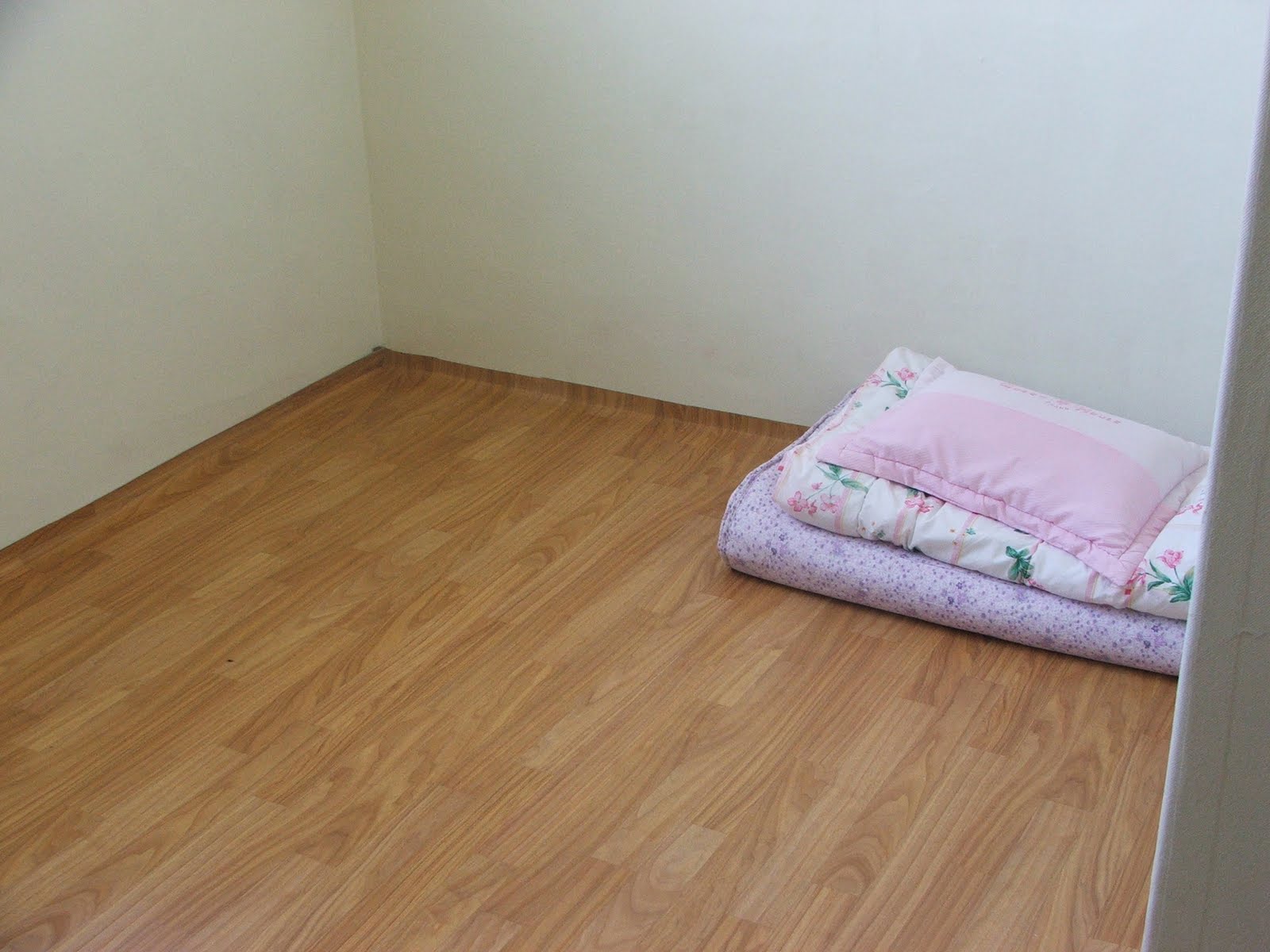
Shown to my room, it was immediately apparent that the decor, fixtures and fitting were a little scant, while the answer to my question

"where's the bed?", met with Gemma's reply "what's a bed?". To be fair the little mirror is a nice touch!

The communal food consisting of seaweed, sea cucumber, various mollusc's, spiced pork, extremely tangy smoked fish, was placed centrally in bowls on the table, while each of us were issued another bowl of thin, insipid soup topped up with noodles.

While I knew then very little about the history of the conflict between the two countries, it is difficult to remain impartial when you have been in the company of such beautiful people. The gentleman on the left is Jeh Jeong Won, or Peter as he liked to be known to westerners, the Catholic Priest and the first person to befriend me. Having agreed not to discuss the subject of religion, Peter went on to tell me that he knew where most of the birds could be found on the Island, but unfortunately had the Lord's work to do that day. Having readied myself to make a lone search, Peter returned and informed me that the had spoken to the Lord and was sure he wouldn't mind if he entertained this visitor to his Island and continue his works the next day.


The food was much the same at each meal and it seemed the best table manners were determined by the person who made the loudest slurping noise. Gemma seemed quick to realise the food was not quite to my liking and once she discovered I liked fried eggs, served me 'a dozen' at every mealtime.

I can only hope that ALL of these lovely people are safe and well tonight.

Monday, 22 November 2010

All The Leaves Are Brown, and The Sky Is Grey - Mamas & Papas

While the sky was completely overcast and the temperature continued to fall as I left home this morning at 07-30, the wind had dropped and there was altogether a better feel to the day. By 09-00 much of the cloud had disappeared, making way for some prolonged periods of sunshine and generally warming things up a bit.

Apart from the arrival, or maybe appearance from cover, of a small flock of c11 Long-tailed Tits things were much the same in the cemetery so hurried on across the road to Radipole. There, both Water Rail and Cetti's Warbler were vocal and in short time this years breeding male Marsh Harrier put in an appearance.

Distant but discernible shot of the male Marsh Harrier

This small group of Gadwall seemed a little unnerved by the presence of the raptor, but the few


Pochard on the other side of the lake seemed untroubled.

On the Wader front, Green Sandpiper, Common Snipe and Lapwing,all as singles and all in flight put in brief appearances, while later the Snipe tally rose to double figures.

A number of Mediterranean Gulls were on the shingle island outside of the Visitor's Centre in company with a few Common Gulls, a couple of Shelduck and the |Hooded Merganser, always nice to see.

At Ferrybridge the Brent Geese were there again in good numbers, as were several Red-breasted Merganser, a couple of Little Grebes plus c4 Little Egrets. Waders were once again at a premium with only c6 Ringed Plover, c3 Dunlin and c2 Oystercatchers being noted.

Brent Geese a few images of birds both

in flight (a 'skein' of Geese) and

on the ground (a 'gaggle')

There were also a good number of Mediterranean Gulls here too, and while not counted a guesstimate would be in the high tens?

Walking through the Top Fields a Common Snipe was flushed, while c22 Skylark flew, seemingly off the sea, to the north. Despite the slow wind down of bird numbers as we head further into winter, the staff at the Observatory have been given little respite in a year when 'records' have tumbled in all directions. Of these, the number of

Brambling (this one a female) have far exceeded the the highest annual ringing total for this species, while

Linnet (a male shown) continue to thrive overwinter in the carefully managed and sown fields adjacent to the Obs.

Goldfinch are also numerous at the Bill and I know final tallies will be shown in the end of year report. On my way home, a Water Rail was 'calling' loudly from the sanctuary of Culverwell and later at Sweethill c5 Redwing flew over and to the north.

These 2 Cormorants were posing on the catwalks

in the Weymouth Marina, and after a pint in The Swan I headed home - good day!

Sunday, 21 November 2010

It's An Ill Wind

The signs of some movement of birds this morning were good, even under the cover of darkness. From my back garden there was a Robin already in full song, but more importantly what seemed like good numbers of Redwing flying over given away by their continuous thin, wispy location calls. The cemetery gate was still some way off when I saw the first of these, c6 flying north, then closely followed by a large flock that must have been around the 100 mark.

Once again I opted for the early bus directly to the top of Portland, but on the way it was noted that the Brent Geese at Ferrybridge were reduced by 50% on yesterdays estimate. Deciding to retrace my steps, even if only to photograph the huge depression that is the

Perryfield Quarry

making for a dramatic, even lunar-like, landscape. There was little of note on the way, but soon found I had company searching to relocate yesterdays Pallas's Warbler, without success. In fact by comparison there were very few birds at all, except another Firecrest and a couple of Chiffchaff. Taking a diversion via Wakeham, there was a tree with no fewer than

c29 Collared Doves plus a further c3 close by. In days gone by this would have been normal fare, but as numbers seem to have dropped dramatically this count was noteworthy.

Collared Dove

A little further down the road my attention was drawn to a small flock of Long-tailed Tit, foraging the hedgerow, in company with a second Firecrest.

A report from fellow birder Graham Walbridge of a Woodcock at the hump had me scampering in that direction, but soon pulled up short at the sound of a strange bird-call overhead. Looking up I saw a pair of

Snow Buntings, not at all a common sight in the Island.

The first time I ever saw one of these nifty little birds was on 23rd January 1974 when I thought I had found one in the Admiralty Compound at Portland Bill. With that I raced to the Observatory to report my find to the then Warden Ian Robertson, who told me it had been there for about 2 weeks, blast! These 2 photos are from the archives.

A small stand of Fungi on the way, there was no sign of the Woodcock, but I did turn up a Great Spotted Woodpecker and c5 Brambling on the way. It was now time to head for the Bill where, in transit, there was a single Common Scoter, c2 Raven, a few Gannets and Auks while at the tip of the Island this

lone Turnstone, and a few feet away a

single Purple Sandpiper.

The weather had been a little more chilly today and the wind, in the east at first, did 'back' slightly to the north as the day wore on and became a little more blustery. The forecaster is still predicting much colder weather during this week, so working on the theory "it's an ill wind that doesn't blow somebody some good" there may just be a rarity or two?