'Cold' was my first reaction to the weather this morning, and while it was still beautifully sunny the day was to get colder. With just a single Great Spotted Woodpecker 'calling' in the cemetery I quickly crossed the bye-pass onto Radipole where exposed just a little more to the south easterly breeze things did feel much more chilly. With water levels far too high for anything else but a Mute Swan there was precious little to see here, so with the songs of a few Chiffchaff ringing in my ears I made for the sea front. In the full face of what was close to an icy blast I continued to Greenhill where once again Lesley Godfrey was waiting to be shown even more of our local delights, starting with Lodmoor.
 Coincidentally, we immediately met up with Daragh Croxson who alerted us to the presence of a Little Ringed Plover (above), the Long-billed Dowitcher and a recently arrived Spoonbill.
 With such a haul already in the log, we continued to find our own pair of Greylag Geese at great distance, but just about everything else was reasonable close, a great advantage particularly to Lesley.
 This white (Campbell) 'call' duck, formally used to encourage wild birds into a decoy either to be ringed or in bygone days for the 'pot', was snuggling up to this 'wild' male Mallard and may breed. There are quite a number of these escaped, or simply dumped wildfowl on our reserves, by pet owners who get fed up with them, which in my view don't do the wild population any favours. There are a 'gang' of mutant Khaki Campbell's at Radipole that murder wild birds, while the weakening of the strain by inter-breeding has to be detrimental as well. Put to the RSPB, their logic is "the public like them" so they are left roaming loose. But if the experts of the RSPB say it's alright, then it must be?
 Otherwise, this male Gadwall,
 Grey Heron,
 Shelduck,
 Blackthorn Blossom and
 Magpie were all close enough to make for fine photographs. Also on the Moor we recorded Wheatears, Chiffchaffs, a Curlew and a Stoat.
On our way back from Portland yesterday, Lesley and I had noted the extremely 'low tide' and so today decided to investigate this at close quarters. Crossing to the Preston Beach we immediately clapped eyes on a waterfowl very close to the shore, while through the binoculars I could see it was a 'Diver' of sorts. Most unusual for these birds to venture close inshore this could indeed be the photo call of the week, but firstly there was the matter of identifying it!
 Red-throated Diver


On our way to view the low tide Lesley and I had chance to learn a little more about each other, as yesterday was more about our children, her husband and his work today we turned attentions to what we do and enjoy. I think she already had a full picture of what I am about, so we talked about her business as a professional photographer. There was little doubt about her talent even by viewing at her images on the camera screen, but little did I realise what eminent company I was keeping. Invited to view here web-site, there simply wasn't the time last night but to be presented with just a small example from her full portfolio, my simple reaction was WOW!!!!
 Just a single page from her promotional booklet had me rocking in may seat as I gazed at such luminaries as The Archbishop of Canterbury, Rick Wakeman of rock band Yes, Cherie & Tony Blair, Maurice Gibb of the Bee Gees et al all of whom have endorsed her greater catalogue and signed her own personal 'coffee table' version of her work - WOW again!
I know how many of our readers are interested in Maritime Movements hereabouts, especially shipping that has had close ties with Portland particularly. So here is a copy of an e-mail sent to me by an ardent reader Janet Read.
 The Royal Fleet Auxiliary ship Bayleaf will sail into Portland Port for the last time on Wednesday. The tanker, which has travelled the world for 29 years keeping Royal Naval ships supplied with fuel, will retire after its final voyage on Saturday.
RFA Bayleaf is being laid-up under Ministry of Defence savings. The ship has been acting as the Arabian Gulf tanker for 12 years, in support of the Royal Navy and coalition warships in the Middle East. It has supported UK and coalition warships through the Falklands conflict and both Gulf wars, and during humanitarian operations. RFA Bayleaf, the third ship to bear the name, has sailed 1.4 million miles supporting ships worldwide, conducting over 5,000 refuels. "She has a long and proud service history and we, the final crew, are honoured to be a part of her story," said a spokesman.
Built at Cammell Laird Yard, Birkenhead, it was launched as RFA Bayleaf in October 1981 and entered service in 1982. RFA Bayleaf's final voyage will be from Portland to Devonport on Saturday.
 Through the murk that was Portland Harbour this afternoon, a tanker thought to be RFA Bayleaf lay at the Outer Coaling Pier awaiting her final passage on Saturday. We salute all involved in her design, construction etc and especially 'All Who Sailed In Her'.
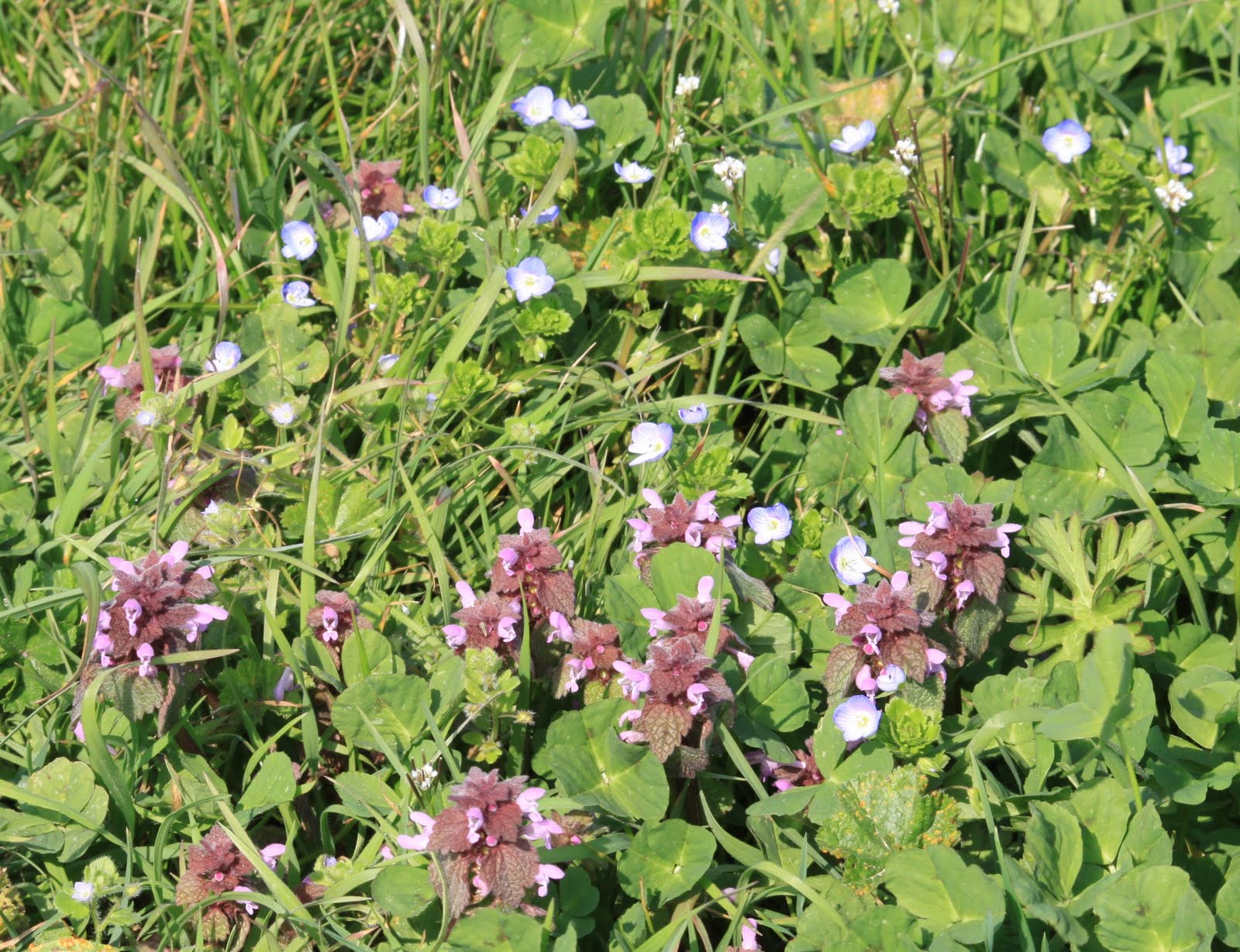 These Speedwell flowers with an unidentified purple species were on the grass verge at Ferrybridge, and
 we found c2 'live' Winkles' on the Fleet side of the fore-shore. Insignificant, maybe, but its been many a day since I've seen them here, their usual habitat is on the harbour side.
 Still a little while before the end of the 'ebb', we decided to visit Angela Thomas and Colin Ousley at the Fleet Visitor's Centre where we were (as usual) made very welcome and enjoyed a cup of tea - Thank You both.
 While there we chatted to 4 young people from the Weymoth College at Cranford Avenue who were busily making a video documentary about the development of a Barnes Wallace invention, the Bouncing Bomb. The Fleet was used quite extensively in it development, many being dropped along its course. As youngsters we would occasionally go to Langton Herring to see those that had been left there from the trial, but later they were carted off to the Royal Air Force Museum at Hendon. It was great to meet these people as well.
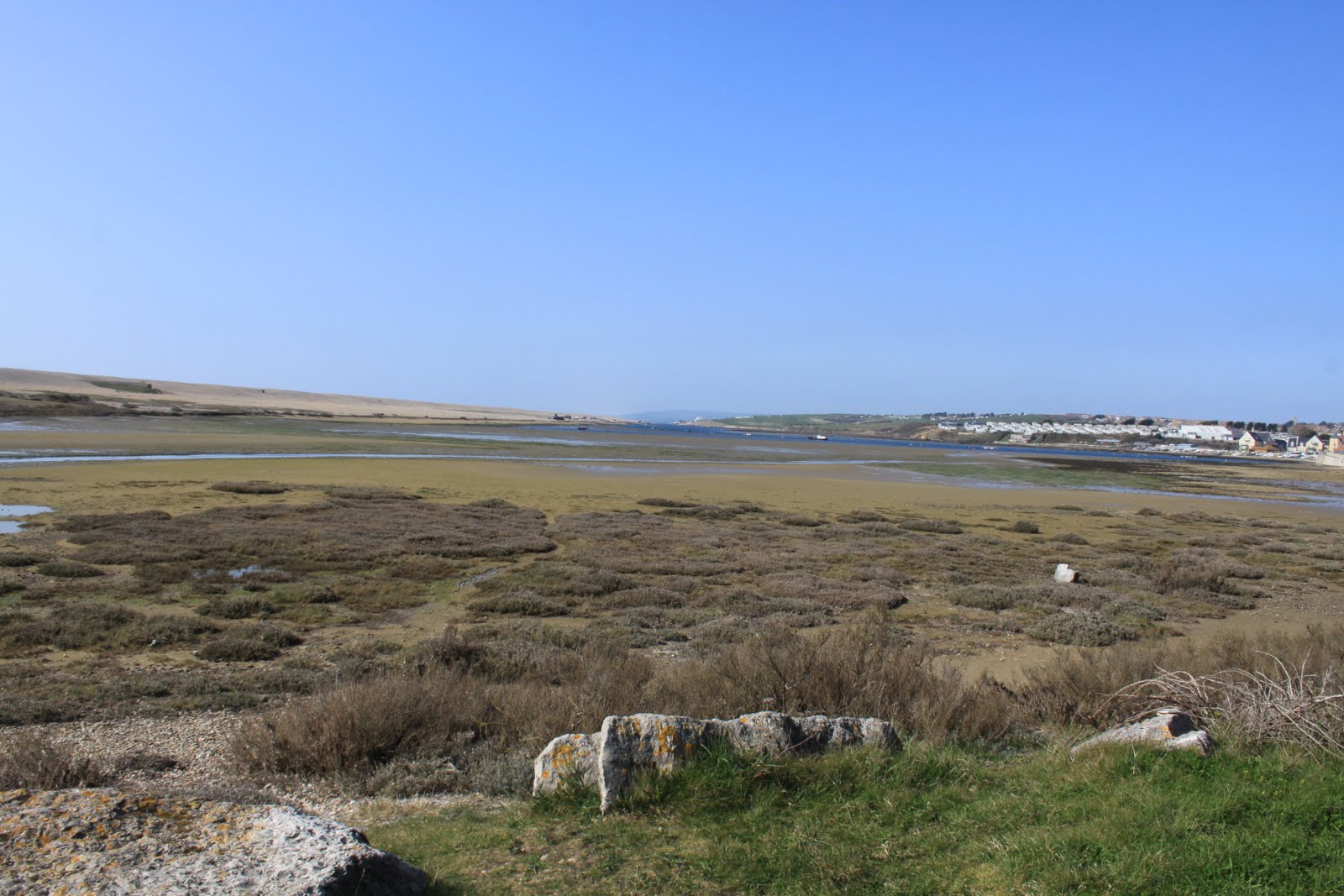 The tide now right back, this was the view from the Centre.
 The 'spit' of sand uncovered between the black hut and the bait digger is rarely exposed at low tide, and probably the most exposure I have seen here.
 That also goes for the one that runs from the Oyster Beds, and today almost uncovered to the east wall.
 Over on the Portland Harbour side (looking south to the Island) you could almost walk to the small craft moorings.
 While looking north it's doubtful I've ever seen the tide so far out. Yesterday, the ribs that operate from the Fleet side of the Ferrybridge pub were grounded for a time complete with the 'divers' they had taken out for the day.
 Lesley was also very interested in Sandsfoot Castle, one of Henry the Eighths coastal defences, so here's a picture for you.
 Finally, as we made for the bus, and home, this male Red-breasted Merganser also past close inshore to a volley of camera clicking.


