Tuesday, 26 April 2011

Kites - Simon Dupree & the Big Sound

For the dozen or so people in the country who, for whatever reason, missed the BBC2 programme Nature Watch from Portland Bird Observatory (PBO) last night, here are a few stills.

PBO Warden Martin Cade hands the programme presenter a Willow Warbler caught moments earlier in one of the 'mist nets'.

From the Obs garden this tiny little bird, that has likely travelled from South East Africa, is gently placed in a cloth bag to be transported to the 'ringing hut'.

Justify FullHere, among several short procedures of measuring, sexing etc, a small metal ring bearing a return address is placed around the birds leg

before finally being popped into a pot

and weighed.

All that is left to do then is to release it in the hope that one way or another the ring is returned with full details of bird, location found and any other relevant details.

As for the rest of the programme, well these days I seem to be controversial enough so I'll keep my own council, but it was fantastic to see

The Portland Bird Observatory deservedly get 'Top Credit'.

Did I hear someone say "sad ol' git sat by his TV with a camera"?

As for this morning, the north easterly chill remained as a result of a fresh breeze, but there was no cloud, plenty of sun and the potential of another fine day. The cemetery was quiet, but once again I was met at the Radipole gate by Steve Morris who tells me that at least one of the young Robins is now on the wing, and the 2 Lesser Whitethroats are still singing at the top of their voices.

At the top of the reserve a pair of Marsh Harriers were quartering the reeds, but keeping their distance,

while one or two Cetti's Warbler were showing quite well.

Arriving at the main bridge at the optimum moment I watched first one

then a second Common Sandpipers drop into just about the only perch available to a small Wader on this reserve. With the water level 'still' high enough to float a VLCC (Very Large Crude Carrier)
they were soon gone, to more suitable habitat. All else of note here was a single Black-tailed Godwit, which had found just a narrow strip of mud, but there were NO Hirundines (Swallows & Martins) so I moved on to Lodmoor.

Things were a little more lively here as this passing Whimbrel greeted me with its rattling call, while one of 4

Lesser Whitethroats allowed me to do a little rattling of my own with the camera.

Stopping to photograph this Marestail, I looked up to check out the screaming from above to

see my first Common Swift of the year (6 to be precise).

For novelty value, the long staying escapee Bahama Pintail put in an appearance before I disappeared towards Ferrybridge. Lucky for me Angela Thomas, now 'second in command' at the Fleet Reserve spotted me waiting at the bus stop an offered a lift to her work place where it was my intention to photograph

the annual 'carpet of flowers' all the way along Beach Road (unfortunately not shown to best advantage in this shot) comprising mostly of

Thrift and

another flower I'm unsure of, is it one of the Campions?

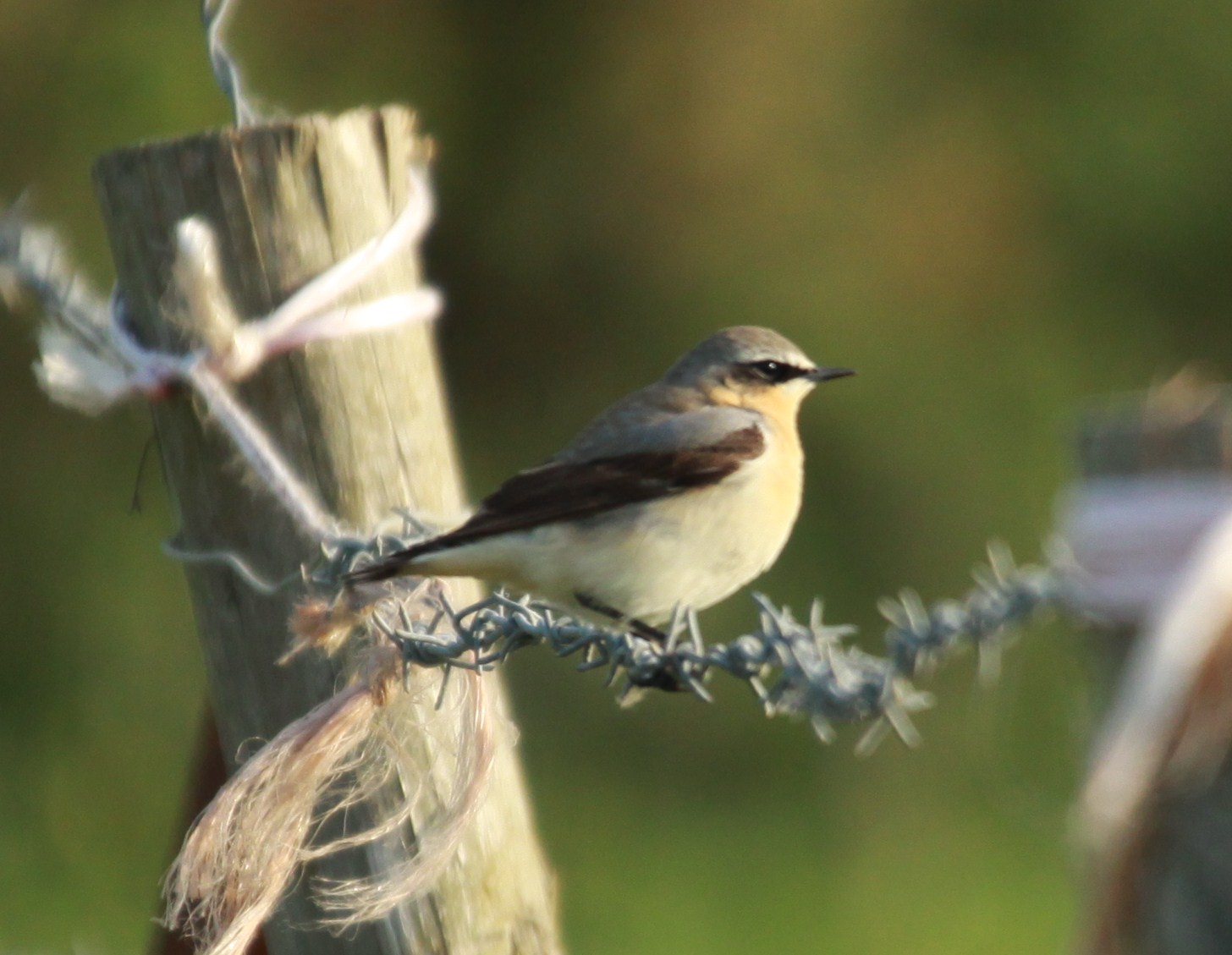
These are Daisy. Onward to the Observatory where they were having a mini Purple Patch with the arrival of a Red-rumped Swallow and a Spotted Flycatcher but unfortunately not seen by me.

The best I could do there was this male Broad-bodied Chaser, so it was home for me and opening my e-mails there were a couple of very interesting photographs the first from Nick Stantiford who had captured these displaying

Red Kites, surely this species is due to breed in the county

so we live in hope!

Secondly, Peter and Debbie Saunders, always alert to a good photograph, this

Common Buzzard complete with Rabbit

flew over their house yesterday evening - what a shot!

Thank you both for the photographs and also to ALL our readers - Keep the Faith and pass on the LINK to your friends!

Monday, 25 April 2011

Take a Walk on the Wild Side - Lou Reed

The weather was a full jacket colder today with the wind still centred around north east, fresh and with the sun struggling to burn through the haze it was a chilly morning. None of this seemed to phase the holidaymakers who, even at 07-00, were positioning towels and driving in windbreaks on the 'sands'. It may have been the conditions that kept the birds away with little to log even as far as Ferrybidge, and even there just a dozen each of

Ringed Plover and

Dunlin, now in 'black bellied' summer plumage,

4 Shelduck (these 2 plus 2 fly-overs) and single Oystercatcher, Turnstone plus a very bright Yellow Wagtail were not enough to tempt me to linger.

The only minor milestone there was that Little Tern numbers.

for me at least,

reached double figures (11) my personal highest total thus far.

Between Barleycrates and Reap Lanes the situation was in sharp contrast to yesterday, when Wheatear were counted in their hundreds and other common migrants were well represented. Today my count of the afore mentioned was 9, with again just a few Swallows and singles of Blackcap and Tree Pipit to make up the day total.

Further on this small bush looked rather interesting but I cannot find what it is, while 'steaming' round the Bill you only had to be able to read to identify the

Sea Cadet Training Ship 'John Jerwood'.

In the Bird Observatory garden there was this Eyed Hawk-moth which is one of the more common Hawks,

and named thus because when attacked by a predator it spreads its fore-wings to reveal an eye-like pattern making it look far bigger that it is.

On my way back I stopped to view this Bittersweet (which has always been known to me as Woody Nightshade??) at which time there was a text alerting me to a Wood Warbler on the Rodwell Trail. Just half a mile or so from my house this was most convenient and after taking a look at this dozing

Grey Squirrel I herd the Warbler 'trilling' from high in the Sycamore Trees. Following its movements for a while, it suddenly shot off down the train (singing as it went) but the singing continued above me. 3 of us saw 2 separate birds, which was a real bonus. With this 'first for the year' under our belts, Dave Tissington and I then set off for Ringstead in search of Nightingale, and on the way encountered our first


Wall Butterfly and

Holly Blue

and even though Orange-tip was seen last week today there was chance of something of a photograph. In all we had 2 Nightingales, which was a 'Year Tick' for each of us, and after watching some emerging

Brown-tailed Moth caterpillars we headed home.

All else of note along the way were 2 Spear Fishermen, a sight not often seen around here these days. Back in my youth just about every young man had at least a go at the sport which I pursued for many years.

The 'Year List' now stands at 233, of which 186 have been recorded in Dorset.

PS - Of all things by neighbours Roy and Joy have just passed half a Christmas Pudding, complete with hot custard over the garden wall, so it just remains to say Yum Yum!

Sunday, 24 April 2011

The Alpine Maid - Traditional Song USA

With a continued chorus provided by Blackcap, Coal Tit, Goldcrest, Willow Warbler etc, etc, the only change weather-wise was just a few wisps of high, cirrus cloud and a wind that had 'backed' to the north, increased to a gentle breeze bringing with it something of an early morning chill. That's all it was in fact, as before mid-day it had dropped away to zero making for yet another Summer like day - the holiday makers must be loving it.

In the cemetery I cast my mind back just a short 3 months when this fruit tree, as regular readers will remember, was favoured by many of the winter Thrushes (Redwing & Fieldfare) while deep snow lay on the ground.

Once again I favoured an early visit to Portland but as ever took a long look across Radipole Lake, as shown above.

With some minutes in hand before the first bus of the Sunday service, there was time for more viewing of the local scenes, this the Inner Harbour, Weymouth

and from the opposite side of the Town Bridge the Outer Harbour and the gateway to the open sea. With precious little at Ferrybridge, it was directly to Barleycrates where the birding was in sharp contrast - birds everywhere.

OK, most were Wheatear, over 300 by my estimation, but in addition a few Swallows were still passing through, and unusually 2 feeding on the ground with the Wheatears. A total of 4 Whinchats, 5 Whitethroat, 2 Stonechat and singles of Redstart (a male) and Grasshopper Warbler.

Reaching the West Cliff, this vessel was seen laying to a single anchor and carrying blades for wind turbines, but I just couldn't see the name. I needn't have worried as my friend Roy Henderson has a house that has a better view over this stretch of water than the Coast Guard, and had already text me telling me it is the M/V Liamare. Presumably these blades are for the proposed 'wind farm' to be built between the Purbeck Peninsular and the Isle of Wight, and another huge advantage of constructing such an energy source off-shore little needs transporting by road.

Not the only craft in the Bay as the Charter Fishing boys were out today 'mob-handed' - 'tight lines you lot!

All that was seen between here and the Bird Observatory where a few of the breeding Fulmar, once again lots of Auks (Guillemots and Razorbill) but no Puffin today, while some had seen both Manx and Balearic Sheerwater - oh for the latter! However, at the Obs 'good fortune was destined to strike very quickly, and when someone told me a

Subalpine Warbler had been caught, I thought it was a 'wind-up'.

The range of this dainty little bird, a female in this instance, usually stops short of North Africa and Southern Europe, but this one seems to have overshot and made the day of a lucky few.

Fitting into the category of 'Rare' just a few do show up on our shores each year, so it would be a great shame not to show it at every angle possible - so here you are!

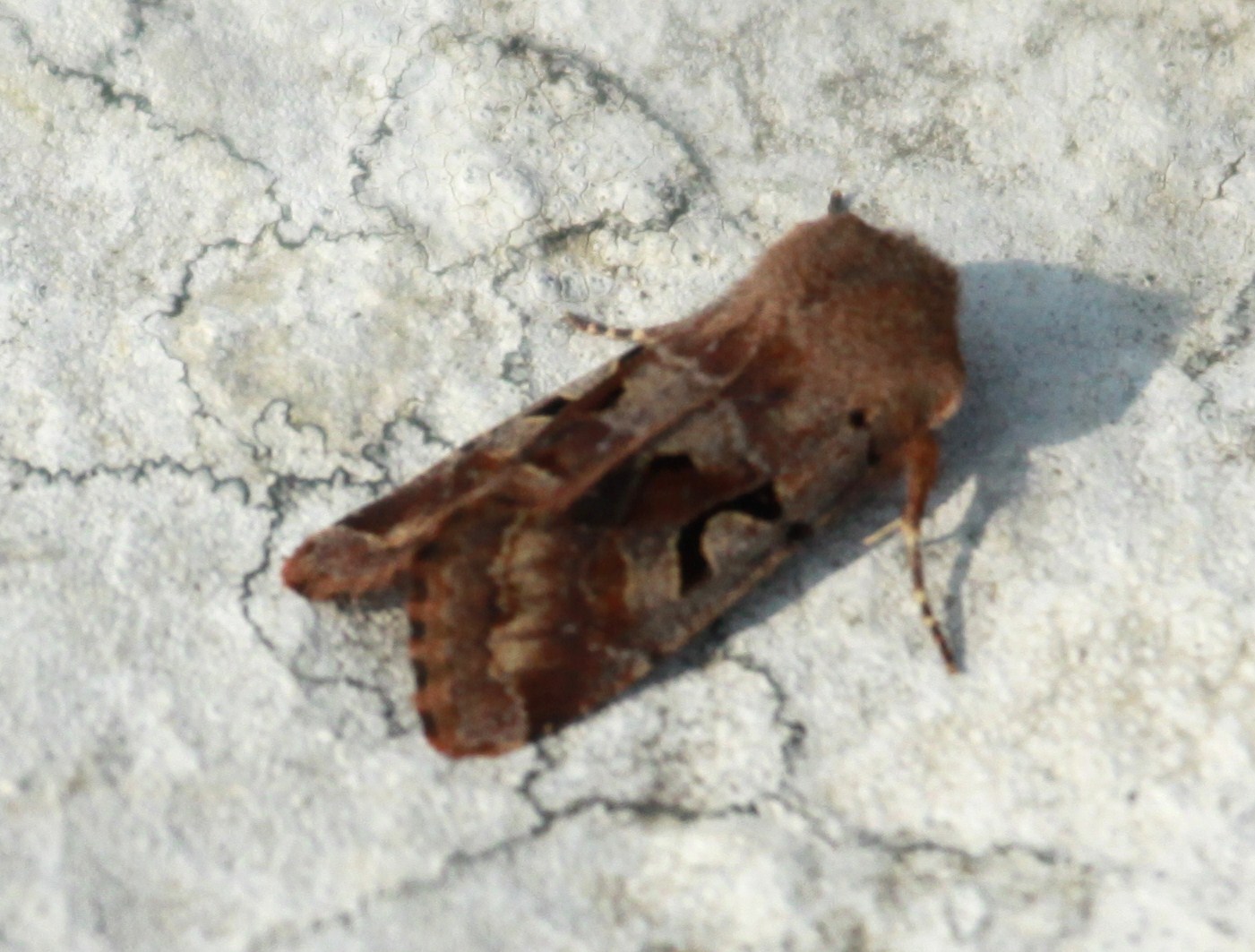
During the lull and a coffee that followed, there was time to look through one of the Moth Traps laid in the Obs garden overnight, and while the content was just 'common fare' I was mildly chuffed that my memory was still working at least a bit.

Powdered Quaker

Hebrew Character It was now time to head home, but just before leaving a

Chiffchaff was caught. Perhaps not the most striking of the British Warblers and likely the most common, but it is

remarkable in that some can, and do survive even the most severe winters GB can throw at them. In addition, all birds take on a new dimension when viewed 'in the hand' so I was more than please to see this one.

Chiffchaff head detail.

Dame's Violet

Finally, a word about the company I enjoyed today, not unusual at the Obs, but today 5 of these were children (including the Warden's 2 daughters) and a great pleasure to talk with these lovely people and give them a chance to have a go with a 'big boys' camera. It also makes me feel
THE FUTURE IS SAFE - THANKFULLY!