Saturday, 23 July 2011

Awaiting the Migration

There was a terrific end to the day awaiting me yesterday, but before that I took a little time to walk Weymouth Beach to look at the new 'fixtures and fittings.

As part of a huge and much needed refurbishment for the town, stages, stalls, amusements, children's rides and cafes have been erected on the sands making for great improvement. However, they seem to have taken up about 20% of the space (at high tide) and as locals here know at this up-coming season things were already shoulder to shoulder. This is not meant to be a criticism as any improvement is most welcome.

Later, I was met at the Tapas Bar on the sea-front by my lovely daughter Julie and her equally lovely partner Nigel to enjoy a belated birthday treat. Treat it was indeed as we have visited this excellent little restaurant on many occasions, but last night the food was better than it has ever been. If you have a celebration I would heartily recommend this establishment.

This morning there was little need to linger at either the cemetery or Radipole as there was nothing new to see. There was however a late report from yesterday of 2 Ruddy Shelduck (thanks to Geoff & Sheila) at Lodmoor so quickening my pace I headed there. On the way it was noted that the now beautifully refurbished Jubilee Clock is also back in working order and showing the right time.

This powerful looking vessel was at Anchor in Weymouth Roads this morning and could just be seen to be named Galatea. A little investigation came up with these details:-

Trinity House’s Multi Functional Tender (MFT), GALATEA, delivered in 2007, has been designed with buoy handling, wreck marking, towing and multibeam and side scan hydrographic surveying capability. At 84m long with a service speed of 13 knots, she is fitted to the highest and most modern technical standards.

GALATEA is a state of the art vessel enhanced by many additional features including DPAA dynamic positioning, a range of high specification survey equipment, a 30t lift crane, a 1.2m² moon pool, a large working deck with the facility to lock containers on deck with plug in to 230v or 400v supply, a helicopter-landing pad and a high-speed workboat.

This I can tell you is my kind of ship!

At Lodmoor there was no sign of the Ruddy Shelduck, and I later learnt that they had quickly transferred to Radipole where they remained for no longer than 5 minutes. There was also an amendment to identification re-naming them as Cape Shelduck an African species but obviously escapees here. There were however a few Lapwing,

a good number of young Common Shelduck (our own resident species) and a single

Greenshank which could easily be one of the 2 reported here yesterday as flying across Radipole. A marauding Peregrine was 'spooking' everything on the Moor which included 5 Black-tailed Godwit, 4 Common Sandpiper, 3 Dunlin, 3 Little Egret plus singles of Sandwich Tern and Whimbrel.

Moving rapidly on to Ferrybridge, where like the past couple of days the tide was low and about to turn. On arrival all 8 adult Great Black-backed Gulls took to the wing and disappeared down the Fleet, while everything else stayed put

including a couple of juvenile Great Black-backed Gull.

Other Gulls present included a few Black-headed Gull

and several Mediterranean Gulls

which were mostly 'ringed' birds.

The start of the 'flood tide' was obviously carrying some food source with it as many of the birds took to plunge feeding including the Med's above, and

this single Common Tern.

On Portland and more particularly at Culverwell this beautiful, large Mallow bush was in full bloom, while from the moth trap at the Observatory

this Magpie Moth was one of several caught overnight.

On the bird front things were still fairy quiet there, but the move south has surely started with both Swallows and Sand Martins gathering, and this Willow Warbler falling to the 'mist net'.

There were a few more photographs from today which due to time constraint will be published tomorrow. To end today, regular readers may remember a post of a few days ago when a photo of Wild Carrot was shown with 2 Soldier Beetles which I considered had laid 'little red eggs'. Wrong again, as I am advised by my mate Sheila Edwards that the center of these blooms usually includes some red petals.

Friday, 22 July 2011

A Bad Day For Grasshoppers

Believing there is usually more than one way to 'skin a cat', even though we did not see yesterday's star turn we know a man (or two) that did. With kind permission of Ian Dodd, seen here photographing the Paddyfield Warbler, and Martin Cade we can bring these images of

this extremely rare bird to a wider audience. More or less confined to the Continent of Asia, this is the first time on record

that one has graced Dorset.

After only a few short paces this morning it was soon apparent that it was going to be a day full of bird, with many dozens of Common Swift and House Martin flying high over Westham and no fewer than 23 Blackbirds counted in the cemetery during the first 10 minutes.

Just 2 of the 5 Collared Doves seen there, but I have been unable to locate any of the Goldcrests that are singing to confirm breeding. Over the road at Radipole Lake one or 2 Reed Warblers were still singing, a few Sand Martins where showing as 2 Greenshank flew over the reed-beds at quite close quarters.

This single Grey Heron was patiently waiting for prey as 2 Marsh Harriers took to the air close to North Hide but too distant for the camera.

Hunting adult Common Terns have been a feature here every day since my return,

but today they had been joined by these 2 juveniles, most likely from the Lodmoor colony, saving Mum & Dad the flight back each time.

They were certainly making plenty of noise about it, and taking to the wing each time a parent bird approached with food.

This adult Lesser Black-backed Gull on the car park was too much of a temptation, as were a

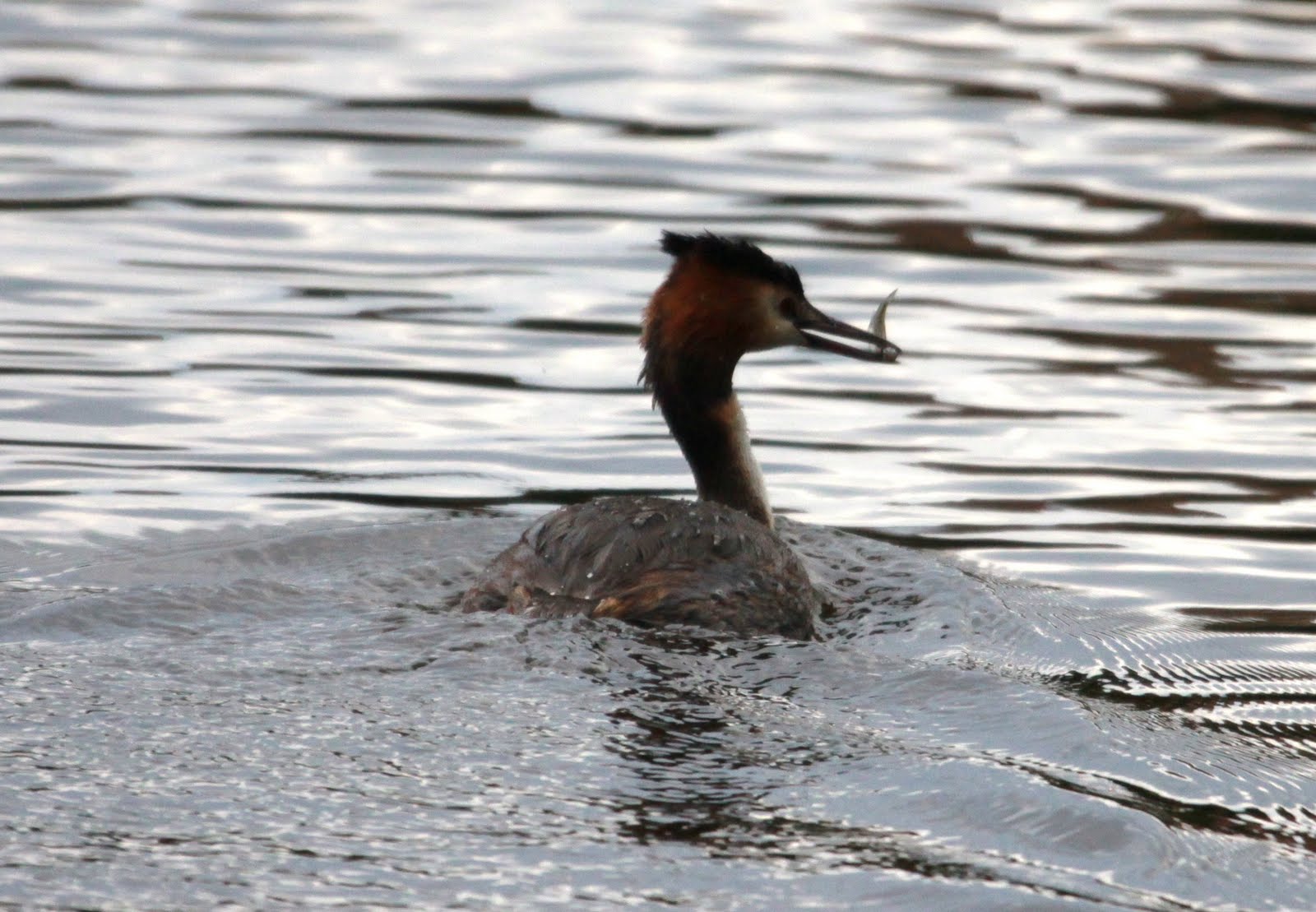
couple of young Great Created Grebes, this one spending some time trying to catch insects.

Something slightly more substantial was on offer via a parent bird

tempting the juvenile to quit its Flycatching. Once again deciding to PAY on the bus to Portland, I decided half way not to go the full distance to Avalanche but alight at Barleycrates, a full 10 pence cheaper but the driver wasn't doing any discounts.

The first bird encountered, a Warbler, looked at a distance to have a 'crown stripe' which was of great interest

but I was unable to close the distance on it and proved to be a Sedge Warbler anyway, so panic over.

There followed a series of shots of Grasshoppers, this one firmly clamped in the bill of a Meadow Pipit

while the next had fallen to this most approachable

Skylark. There were also 2 Willow Warblers along this section of path and a probably Garden Warbler that simply wasn't seen well enough to claim.

This Stonechat hadn't managed to catch one yet, and continuing along the West Cliff

neither had this Great Tit

nor the 7
Whitethroats, in company with 4 Chiffchaff, around the rotting hay bales at the end of what used to be the Admiralty fence.

Down at the existing Admiralty compound the Stonechats seemed to be having far more success with both male and

female appearing to have Grasshoppers. It may be of interest that the cliffs are devoid of seabirds, and except for a 'calling' Dunlin, flying south, there was nothing of note seen from the Obelisk.

There was however something most worthy of note as I neared the Bird Observatory, my old Shipmate Barry Sellen and wife Annette recently returned for their second home in France and making ready for the Summer Holiday with their family 'out the Bill'. Great to see you both!

At the Observatory there had been a decent overnight catch in the Moth traps, most notably this 'Fine Pair' (as Pink Floyd would say) of rare Bedstraw Hawk-moths.

In addition there was a fly-over Yellow Wagtail which alerted us by 'calling', but this photograph comes from the archive and is dated May this year.

Thursday, 21 July 2011

'Dipped' Paddyfield Warbler

The sun showed its hand early this morning, and also in sharp contrast to yesterday it was warm and just about windless. Fine day for a walk along the Rodwell Trail thought I, and with low water timed to perfection there maybe a few Waders at Ferrybridge at the end of it.

Not unexpectedly, the first Butterfly to hove into view was the first of dozens of Speckled Wood.

Greenfinches were singing from high perches, but the 2 or three Bullfinches that were equally vocal remained under cover.

Gatekeeper was next favouring both Ivy and

Great / Hedge Bindweed while

all the Red Admirals seemed content on the old favorite Buddliea.

All of this before the Isle of Portland opened up before me bathed in bright sunlight and topped with just a few white clouds.

Wood Pigeon taking advantage of the rapidly ripening berries, as

this juvenile Herring Gull sat patiently on a roof top waiting for Mum to return.

There was also one for the Jockanese (especially those on the Buchan Alpha) this splendid, blooming Thistle.

At a glance, the only thing I could identify on the foreshore at the Bridge was Pete & Debbie Saunders who had again beaten me to the punch having already been there a full hour. There were a few Sanderling still, but by no means as many Dunlin as yesterday, and a bunch of 11 Sand Martins did fly over and to the south. However, there was an interesting selection of Gull, albeit the more common species with this

juvenile Black-headed Gull voted 'best in show' for me.

The adults weren't bad either

but in comparison with a Mediterranean Gull close by, no contest!

A few more shots of Mediterranean Gulls in the vicinity.

A couple of these Black-heads in moult and showing strange head colour, reminded me rather of Grey-hooded Gull.

That's when the phone rang and Martin Cade, the Warden of the Portland Bird Observatory, related the story of his encounter with a Paddyfield Warbler earlier in the morning.

Mutual friend Ian Dodd, seen here with local birder Fred Alway, had been 'mist netting' at his secluded patch of reed bed on the Fleet when he trapped an Acrocephalus Warbler that he wasn't quite sure about. Doing the right thing he recruited some help and it was confirmed as a Paddyfield Warbler (the 'first' Dorset record) and was then released back where it was caught. A bird of such magnitude was sure to raise a lot of interest, but when arriving at the 'difficult to access site' I was the only one there. I did meet Ian and Fred briefly who told me the story, quickly high-tailing it to the capture location. Obliged to spread the word, I was later joined by 8 other Dorset birders all joining me in the vigil to relocate this little gem. To cut a long story short, as far as I am aware it was not seen again, but once again convey my Best Wishes to Ian on a marvelous find / catch (I know how you feel Mate).

A few Fungi on the way home.

Throughout our wait the Army rife range at Chickerell was active, not making it at all easy to hear anything let alone a tiny bird!

Final note:- Forget the News of the World, remember where you heard it first and no need for Phone Hacking when you have enemies in your camp!

I receive texts and e-mails from a surprising variety of quarters (not least from my RSPB 5th columnist) about the happenings within the local RSPB, the volume of which precludes me from publishing most as there would be no room for anything else. However, one received today is considered worthy of publication and is done so Verbatim.

This news will please you! Nick Tomlinson went for another job locally and apparently got it. Looks like he's leaving Radipole now he's done all he can to destroy it. Will keep you posted.