Friday, 13 January 2012

Caribbean Queen - Billy Ocean

A fine start to today's post as the 161st country, and the the first addition of 2012, joins the Country Readership List. The extremely beautiful, jewel of the Caribbean, Saint Lucia where in March 2000 I was fortunate enough to pay a visit and remember it with great affection. We extend a warm welcome to our new readers and hope they might pass on the link to all the friends in the country and elsewhere. Thank You!

A dark and threatening looking sky combined with a fresh westerly breeze gave the feeling that the day was likely to be over very soon after starting, but the clouds rolled through to produce a decent spell of sunny weather.

Looking north from the Concrete Bridge at Radipole.

and looking south from the same position early this morning. With nothing to photograph on the reserve, the only report involved an increase to 18 in the number of Black-tailed Godwits, a reduction in both water level and Common Snipe while very few Gulls had gathered here so far today. The exception to the rule came as a male Marsh Harrier took to the air and began quartering the reed-beds, putting all the Teal to flight and revealing just how many there are. About 100 by my reckoning.

At the bus stop this adult Herring Gull was just posing for a shot, so it got one, before boarding and the first trip to Portland this year.

It was good to be back 'in the fold' and enjoy the sight of the active Lighthouse down at the Bill

and the Old Lower Light which most of you know serves as the Portland Bird Observatory. There was prospect here today of half a dozen additions to the Year List, so first port of call was the Bill to undertake a short sea-watch.

Gulls and gannets were feeding at the edge of the Shambles tidal race, including Kittiwake* which was the first of the 6 to fall to the notebook. The photographs were taken aboard the Buchan Alpha Oil Rig some years ago showing above a juvenile

and here an adult Kittiwake. There were 2 great spectacles here this morning, the first involving many thousands of Auks,

Guillemots and Razorbills, buzzing around backwards and forwards but in no particular direction. The second, was to see a Merlin (our smallest bird of prey) chasing a small song bird out at sea, and then to become the chased itself. From nowhere a Peregrine swooped in and, from what could be seen, made contact with the much smaller Raptor which eventually flew off to seaward.

The scarcest of today's sightings was this high and distant Red-throated Diver which, had it been a little closer

would look a little more like this.

Other birds on the wing included this 1st winter Great Black-backed Gull in company

with an adult Great Black-backed Gull.

The second Year Tick was a single Purple Sandpiper

which barely moved from the rock on which it was perched, while all else included 3 Stock Doves,

this Skylark, one of several very vocal birds,

and this unseasonable Bluebottle. Unfortunately, Fulmar, Chiffchaff, Little & Short-eared Owls didn't show so will have to wait for another day!

The Year (January) List now stands at 164

drill down10.00%SurinameSuriname
drill down10.00%CameroonCameroon
drill down10.00%FijiFiji
drill down10.00%AlbaniaAlbania
drill down10.00%GuyanaGuyana
drill down10.00%ZambiaZambia
drill down10.00%NigeriaNigeria
drill down10.00%MacaoMacao
drill down10.00%BotswanaBotswana
drill down10.00%Saint LuciaSaint Lucia
drill down10.00%ArubaAruba
drill down10.00%


drill down10.00%Turks And Caicos IslandsTurks And <span class=

drill down10.00%GhanaGhana

Thursday, 12 January 2012

A Matter of 'Lif-er' or Death - Iron Maiden

My first encounter with bird-life this morning was a Song Thrush, in the cemetery, singing its little head off but that was not the only sign of the Springlike conditions. The sun was out, the sky was blue, there wasn't a cloud to spoil the view and it wasn't 'raining, raining in my heart; and along with a few early budding Daffodils and Snowdrops it could just as easily have been early April.

Redwings also abound in local gardens, a Goldcrest was also in full song while on Radipole there was evidence of a number of Reed Buntings, 'pinging' Bearded Tits plus vocal Water Rails and Cetti's Warbler.

At the north end of the reserve a small flight of

Canada Geese came noisily into land as common small birds were also well represented, such as

Robin and
Dunnock as usual feeding on the pathways,

as this Blue Tit was happy to pose for a while

before demonstrating some aerobatics.

At the Visitor's Centre Bridge things were completely different with at least 73 Common Snipe counted, while the 15 Black-tailed Godwit remain in place.

However, the most numerous species by a full mile was Mediterranean Gull (most of the above, representing just a small percentage of the whole) were Meds and about the only time I remember having difficulty 'spotting' the Black-headed Gull among them instead of the other way round!

In addition there were also many, many dozens arriving continuously from the directions of the Wey Valley and the Fleet, some overflying while others dropped in.

My own guess-timate of numbers was well over 400 giving great opportunity to study all ages of this brilliant little Gull.

The majority of adult birds were still in 'winter plumage'

but there were a couple already sporting the 'black hood'

of 'summer (breeding) plumage' birds.

Not to be out done, Black-headed Gulls too were showing developing 'black caps',with finally a fine sight of the Hooded Merganser in flight.

Then came the call I had been hoping for, Sheila Edwards announcing that the trip to Calshot, a small village situated close to Southampton in Hampshire, was very much on. Beating a hasty retreat to their house, I scouted around the garden finding more signs of Spring with a

Red Admiral Butterfly on the wing along with

2 separate, but unidentified, species of Hoverfly.

A clear run in perfect conditions though the New Forest and beyond found us in the village just 2 hours later. There was no hurry, or need for such, as what followed was a long, long wait for the object of our desires, so time for a little 'ship spotting' as a number of vessels sailed south through Southampton Water, onward to The Solent and eventually the English Channel.

The first was Nagato Reefer, one of a class of merchant ships known as 'Reefers' or Refrigerator Ships, temperature controlled to transport perishable commodities mostly fruits, meat, fish, vegetables and dairy products.

This was followed by a medium size Tanker, the name of which I failed to note, while all this time

a crowd of some 50 or so birders were gazing into

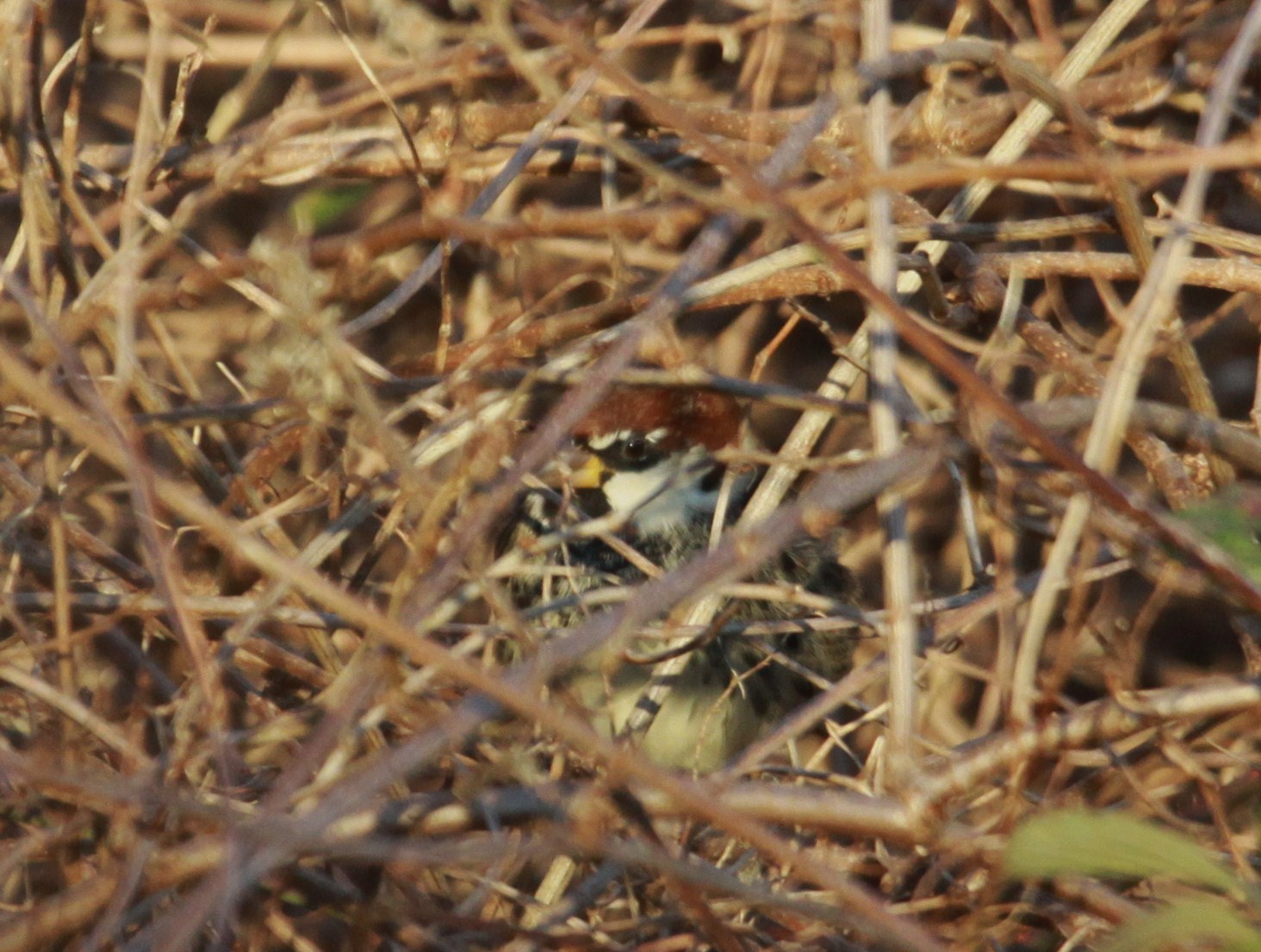
THIS. A massive tangle of Clematis where probably within was our target, seen briefly by some just before our arrival. There was a little respite as there were a few familiar faces among the crowd such as Julian Thomas and Mike Spicer - good to see them!

But then, after a full 2 and a half hours, the call went out to say the bird had been be re-located,

as was the crowd each of us trying for an advantageous view along the narrow strip between two hedges.

Not at all cooperative it remained mainly in cover, slowly moving towards the top of the bush,

where finally, the Spanish Sparrow* showed it's full glory.

The first record of this species in the UK was from Lundy Island in 1966,

while today's bird, which is said to have been in situ for many days, is only the 8th record for the country and a new addition to my own Great Britain List!

PS
El Spadger made it onto the early morning BBC TV News, with reports of the gathering crowds travelling to see it, its possible origins and how it had already charmed one of our own House Sparrows producing at least one 'hybrid' youngster. As we understand it, this is going to be called Hacienda Sparrow - Viva Espania!

The Year (January) List now stands at 162