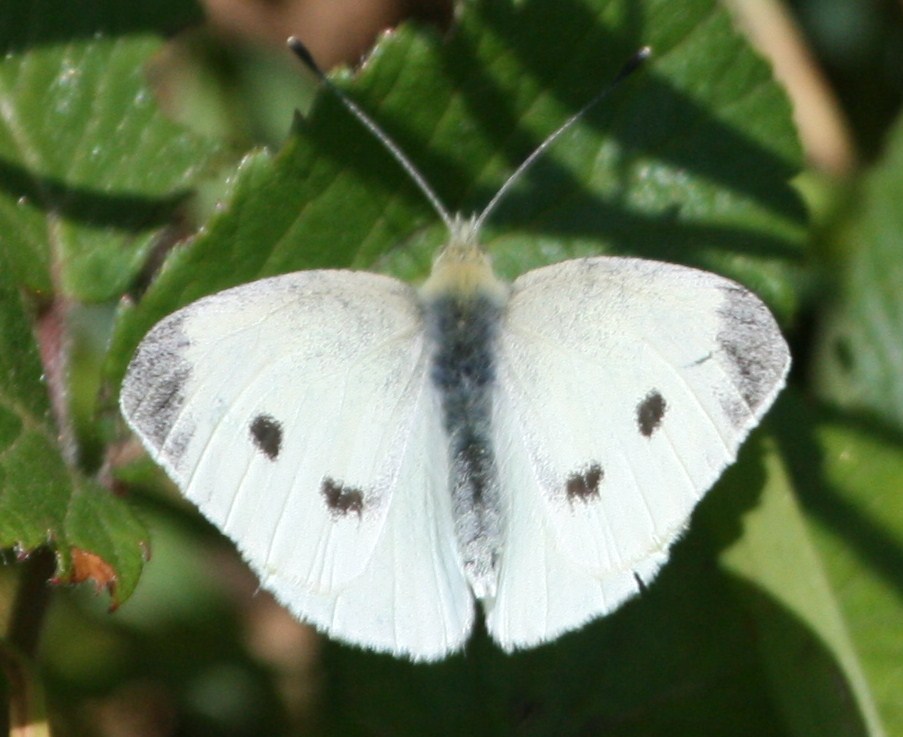
The weather today was a carbon copy of the last couple of days, but my departure from home and once again into the Wildlife Zone was delayed as I caught up on sending e-mails many of them to readers of this Blog. Forsaking my usual circuit, I headed straight for the bus and a ride to Portland. At the bus stop I was asked by 2 lovely ladies if indeed they were in the right place for the Portland bus, which of course they were. It turned out that they were walking the full length of the Dorset Coastal Path and today was set aside to circumnavigate our sacred island. Planning to start at the small village of Chiswell, at the north of the island and at the bottom of a very steep hill, I suggested they stay on the bus and alight at the Portland Heights with me where I could start their journey off with a bang and set them on the right track.
I have to admit to a serious love for showing people around any part of our county, with Portland being the firm favourite, so for these charming people, one from Worcestershire and the other Warwickshire it was the best way I could start my day. Tout Quarry long ago gave up its bounty of limestone and has since lain redundant but not idle. The Stone Firms generously opened it not only to the public, but to budding Masons and Sculptors alike, with the whole area having been strewn with minor works of art. In addition to this there is Lano's Bridge, which legend tells was built by the Quarryman, in 1854, during many lunch breaks, but the piece de resistance has to be walking under this beautiful arch just 50 yards to behold the vista across West Bay, though Fortuneswell, across Portland Harbour and beyond to the Purbeck Peninsular.

My 2 lovely temporary guests beneath Lano's symmetrical arch.
By this time, I was sure they were looking for their own space so I directed them to the West Cliff path but did catch up with each other from time to time when i was able to point out a pair of Ravens, c3 Peregrine, along with:-

good numbers of Fulmar,

Vipers Bugloss
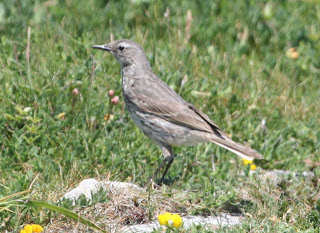
and later describing Rock Pipit to me.

The Island is now awash with Valerian, mostly of the deep pink variety, but occasional pockets of the equally beautiful white strain.
Arriving on the East Cliff, I decided to try and photograph Wall Lizard given the warm sunshine which they soak up to increase their metabolism. Unfortunately, a rock climber had decided to scale the cliff close to the site and was using an electric drill (yes, electric drill) to secure his pitons. Not a hope of a Lizard, but the second prize was a perched and flying

Peregrine Falcon

Peregrine silent running.

Peregrine vocal.

Biting Stonecrop
On the way home I took the 2 photographs below of Avalanche Church in Southwell, the most southerly village on Portland.
In September 1877 a terrible tragedy occurred off Portland Bill when two ships, Avalanche and Forest collided with the loss of 106 people. This disaster and the outstanding bravery of the local fishermen in rescuing the few survivors resulted in a national subscription. The cost of building this church was £1,900 and the church was dedicated to St Andrew on 3rd July 1879. The church has memorials to those drowned as well as testimonials to the bravery of local people. Stained glass windows show scenes from this tragedy.
An account of this maritime disaster is given in Stuart Morris's excellent book "Portland: An Illustrated History".

This Admiralty pattern type anchor was recovered from the Avalanche on 14th July 1986 by local divers, ably assisted by Portland Plant Hire.

What I think is a 'nifty' bell tower for such a small church. Unfortunately, the door is kept locked but one day I hope to gain access and bring you some photographs from within.

OK, its only a 'drain cleaner' but I was amazed at this fantastic rig.

Needless to say both the driver and his assistant were extremely proud of their charge.

Rufous-browed Conebill

Rusty Flowerpiercer

Santa Marta Parakeet (one of several endemics seen in the mountain range).

Tanager Finch
and finally, I feel compelled to return to the issue of the untimely build of the Sand Martin Wall (which unfortunately has found no takers this year) at the Site of Special Scientific Interest (SSSI) that is Radipole Lake. A couple of RSPB members who have been eagerly following my protestations, handed me a copy of the May 2010 edition of the RSPB in house magazine 'Birds'. Starting at page 58 and continuing to 63 there is an 'in depth' interview with Robert Coleman the Reserve Manager at Titchwell Marsh in Norfolk. It has been my pleasure and privilege to visit the RSPB's (self proclaimed) 'Premier Reserve' on numerous occasions, so it was of great interest to read how Mr Coleman exercises his management skills up there.
At question 7 in the article he is asked "How long will this building project (at Titchwell) take"? Answer - (in precis) "you definitely can't rush this kind of project as we can only carry out the work between Mid-July and October each year".
Compare that to when I asked local Reserve Manager Nick Tomlinson, in my home, why the Sand Martin Wall had to be built throughout the 'full course' of April 2010, unarguably the most critical and sensitive month in the breeding calendar. He replied (verbatim) "I decided on the timing (not RSPB HQ) and that's when it's being built".
Question 8 in 'Birds' continues "Why can you only do this work between mid-July and October"? Mr Colman's answer, "In Spring and Summer we cannot disturb 'rare breeding species' such as Bittern, Avocet and Bearded Tit, while in the Winter wading birds, ducks and geese using the reserve need safe roosting and feeding areas. Therefore, working in the Winter would cause too much disturbance".
With the exception of Avocet (only a scarce visitor), all of these species grace Radipole Lake and despite Mr Tomlinson's so called 'survey', to ensure no disturbance, could drop in at any second of the day. Bittern, especially vulnerable, is singularly the RSPB target species to encourage to breed at the reserve, and have been recorded there during all of Mr Colman's 'no building' months. To my knowledge, the last Bittern recorded there this Spring was on the last day of March. Let's just say, hypothetically, that if a 'partner' for this over-wintering bird(s) had dropped in seconds after Tomlinson's survey, could not breeding have taken place?
It is sad to say, that the people who handed me this article are ceasing membership with the RSPB, at renewal, mainly they tell me because of the wanton destruction of the Marsh Harriers nest site in the still not fully explained fire, but also in protest at the April building programme. Surely, especially during these severe economic times, the public are not going to continue supporting these serious gaffs, and like me must want some questions answered. No one can hide forever!
 Coombefield Quarry
 Wall Lizard
 Some of the rock formations at the site.
 Many years of water flow have left these calcium deposits.
 Church Ope Cove, followed by
 Rufous Castle. Built between 1432 and 1460 by Richard, Duke of York and named after William Rufous, son of William the Conqueror, it is also locally known as Bow & Arrow Castle and with so much passage of time its not surprising it needs some renovation!
 Starting to climb the hill again the walker soon comes upon ancient grave stones associated with one of the 2 St Andrew's Churches built on this site. The first dates from the 13th century and was the Parish Church right up to the 18th century, but damaged by the Southwell Land Slip of 1675 much of its stone was used in the construction of St George's Church at the top of Reforne.
 All of these graves bear dates from the 1700's with this one also showing scars of shrapnel from German aircraft in the Second World War.
 also battle scarred.
 A base of one of several columns, now lost.
 This sarcophagus was of great interest to my 2 daughters as we used to discover Portland when they were children. The scull and crossbones drummed up thoughts of pirates and I would embellish the stories.
 Another laying close to the one above.
 Continuing up through the old church arch,
 you get great views of both the church and the castle,
 and later enter the only area of mature woodland on the Island.
 The gateway leads to
 Pennsylvania Castle, build around 1800 by John Penn grandson of William Penn who was the founder of the US State of Pennsylvania. When we first lived on Portland in 1967, it was a 'fine' restaurant since when it has been a private residence, one time the home of Mr Singh owner of New Look ladies clothes shops.
 At the top of the hill and at the bottom of Wakeham is Avis Cottage (front view), named after the heroine of the Thomas Hardy novel 'The Well Beloved'.
 The Museum (rear view) was founded in 1930 by birth control pioneer Dr Marie Stopes, then passed onto Council ownership and recently has been taken over by private fund holders. My fondest memories here, were taking the girls to talk with local celebrity Ned Skinner who was 51 years a quarryman, before becoming the museum curator. Now there was a man who could tell a story!
 and here are a couple of 'memory jerker' photographs for Julie and Lisa, the first showing Reforne Close, their first home,
 and this is No3 where both girls were born in the bedroom to the right.
 Lacrimose Mountain Tanager
 Stygian Owl
 White-tipped Quetzal
 Yellow-crowned Redstart