Wednesday, 26 January 2011

To the Crews of HMS Bee & Ocean

Barely 30 seconds after pressing the 'publish post' button on yesterday's Blog, than I received a phone call from Paul Harris announcing "Waxwings at Canterbury Close"! No more than a mile from my house and in the heart of a large housing estate, with still some daylight left I got over there as quickly as the traffic would allow. Of the 'birding fraternity' it appeared that Luke Phillips had pipped Brett Spencer to the post in finding these infrequent visitors, but with a little quizzing it turned out that Luke had in fact been alerted to the birds by local residents.

Johnny & Janet Read, who describe themselves as avid readers of this Blog ("we never miss a day" John told me) were in fact the 'finders' of the c3 Waxwings as they looked from their kitchen window onto a very small, but heavily berried, Rowan (Mountain Ash) Tree across the road, where they were feeding.

Under a rain filled sky (soon to shed its load) and a cold northerly breeze, I met the Read's this morning more or less still under the cover of darkness. I chose to conduct mt vigil, awaiting the birds, in the comfort of the car but fortunately didn't have to wait long as they soon landed atop a huge tree close by.

Waxwing - Showing only in silhouette, the light was not conducive with clear photography, but at least they were still here and added to the Year List.

Remaining in the tall tree for about 10 minutes, there seemed little doubt that eventually they would fly down to feed,

which they did allowing a few

reasonable images given the conditions,

as the light improved slightly and the rain set in!

This done, I continued my duty to inform others, mostly by text, at which point they flew away. However, this had been the pattern of their behavior since arrival, returning within an hour or so to the food source. Another report, this time on the Rare Bird Alert web-site, was of a Black Redstart at Newton's Cove, under normal circumstances just a 5 minute drive from where I stood, but given the extensive roadwork diversions plus school and work traffic this took a full half hour.

The 'Cove' extends from the Nothe Fort (built in 1872 to protect Portland Harbour, which was then becoming an important Royal Navy base, and played an important role in World War II when the harbour was used as a base by both British and US Navies. In 1956 the fort was abandoned and in 1961 purchased by the local council. It is now a museum featuring models, World War II memorabilia, original cannons and guns plus British and American WWII vehicles) to the east,

along a small tract of woodland, private hoses and the new Department of Environment, Food & Rural Affairs (DEFRA) complex (grey pitched roof)

and bordered on its west bank by part of the Portland Harbour breakwater. (Old stomping ground Ginge?)
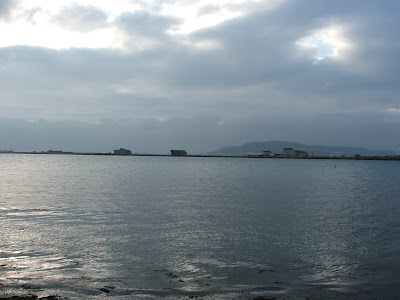
The breakwater extending south, including one of two experimental torpedo firing ranges and the Isle of Portland in the background.

Despite an hour long search, there was no sign of the Black Redstart but other birds to be seen included Long-tailed Tit, Turnstone, Oystercatcher

Mallard

Black-headed Gull

and c13 Great Crested Grebes.

Whether this plaque is new or not I don't know but found it very interesting.

Time now to give the Bill some coverage, and couldn't have arrived at the Observatory at a more opportune moment. Having time only to put the kettle on there was a call from the veranda of

Sooty Shearwater, a single unseasonable bird lingering a good distance off-shore - another Year Tick.

Luckily for me, Martin Cade the Warden allowed me the use of his telescope which afforded very good views of this my favorite bird 'in flight' - 'majestic' he called it, here, here! These photographs are from the archive, today's arrival being far too distant.

Down at the Lighthouse and through the sea mist the shape of a large 'war canoe' could just be discerned, Martin and I agreeing it was most likely HMS Ocean the Royal Navies largest warship.

In addition there were still many hundreds of mixed Auks (Razorbill & Guillemot) flying back and forth, and there were also

good numbers of Gannet (did you ever wonder where they might have got the idea for the design of Concorde?).

The Great Britain Year List now totals = 172

Finally, the highlight of my day was the great pleasure of taking my dear friend Roy Henderson, best part recovered for a recent operation, out for lunch. He suggested Coffee Corner in the Easton Shopping Arcade, neither of which I had heard of, and what a suggestion it was. Staffed, in the main, by people with some disabilities it was an absolute 'eye-opener' as the reasonable priced food was of extremely high quality and plentiful, service impeccable and everyone working at breakneck pace. The seriously bad news is that this magic little eatery is closing down at the end of the month, due to excessive rent hikes, but on the up-side, all employees are to be transferred to another (Outside) Catering business.
We wish each and every one of you the Best of Luck in your new venture.

Tuesday, 25 January 2011

Rabbie Burns - 25 January 1759 – 21 July 1796

The Immortal Bard
"O wad some Pow'r the giftie gie us, to see oursels as others see us. It wad frae mony a blunder free us, and foolish notion."

It was good to get together with a few fellow birders (Paul Harris, Dick Morris, Daragh Croxson and John Down) yesterday evening for a 'pint and a pie' as I like to call it, the latter giving me some useful information on the whereabouts of Grey Partridge and Corn Bunting. Another lovely winter's day was ideal for a run up to Martinstown, a couple of miles south west of Dorchester, to begin the search.

No joy after an hour wandering about, but at a nearby farm there was a small flock of these interesting looking sheep. I have researched them via Google without result, so if you know what they are drop me a line please.

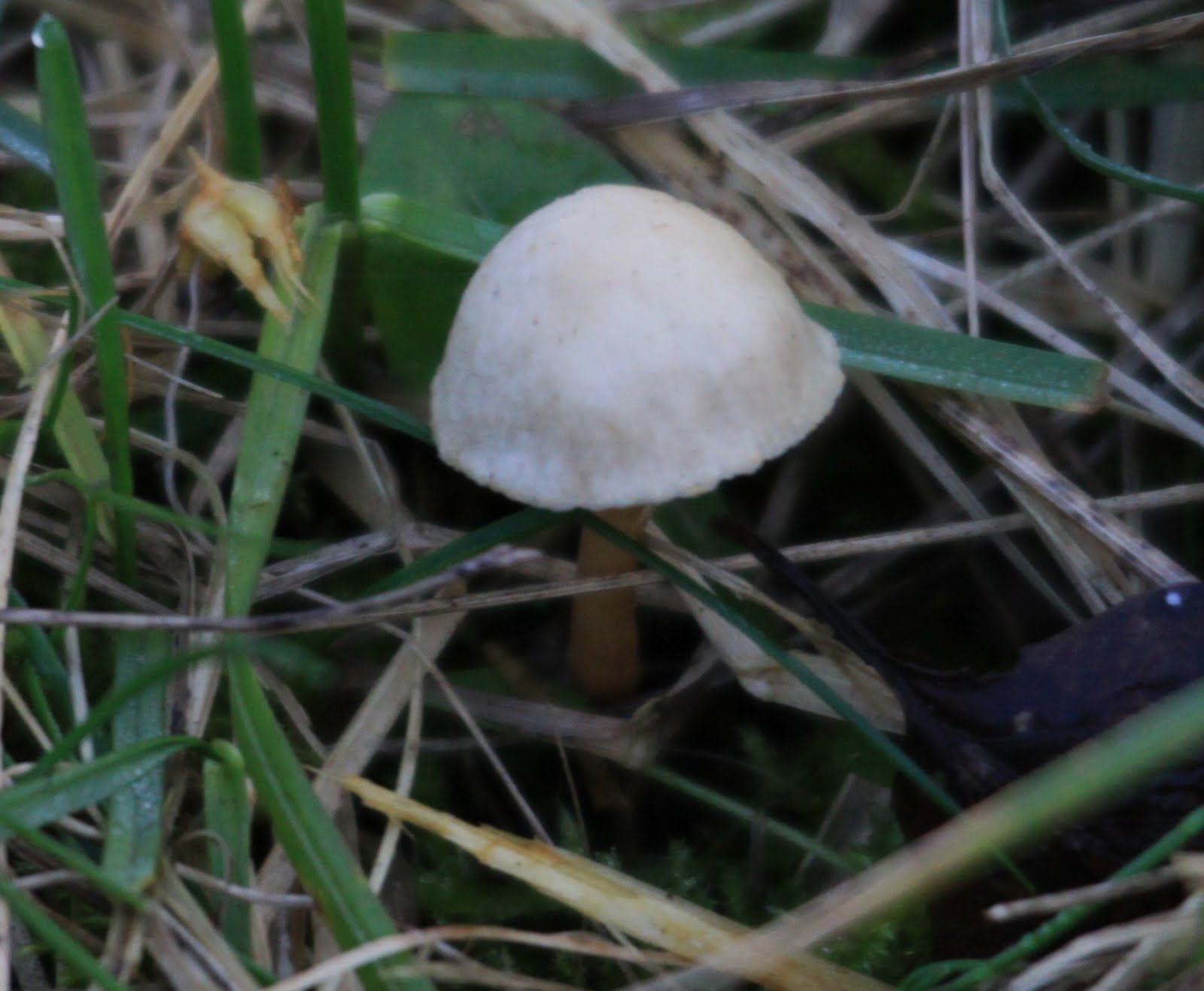
On a roadside verge there was also this small fungus, again unidentified, will yet again have to rely on the Fungal Punk to sort it for me! Anyway, time to try elsewhere and not far down the road

there were 2 trees holding c28 Corn Buntings.

In a farmer's field, I decided to apply my often used theory that it is usually easier to get forgiveness than it is permission, so bowled on in.

The birds did allow me to get fairly close, but the light was poor (excuses, excuses) so not brilliant on the photo front. For those interested to see them, take the Martinstown road from the Monkey's Jump roundabout, Dorchester where before the T junction to the village there is a right turn into bat's Lane. Continue past the farm buildings on the right and shortly there is a metal field gate beyond which is a hill with 2 prominent trees at the crest. The Buntings were in these trees today. Unfortunately, search as I might there were no Partridge viewable to me, but a big thanks to John Down for the info.

So, with little to report it's back to the archive, Australia and the Eye Candy:-

Australian Grebe

Australian Magpie

Australian Pelican

Hardhead

Australian Magpie Lark

Maned Wood Duck

Inland Thornbird

Pacific Black Duck

and finally, Paul Harris sends me this link to an extremely rare bird that seems to have slipped through the fingers of the Birding Web Sites????

http://www.manchesterbirding.com/duskythrushdoc.htm

No Indispensable Man

Some day when you're feeling important;
Some day when your ego's in bloom
Some day when you take it for granted
You're the most important man in the room,

Sometime when you feel that your going
Would leave an unfillable hole,
Just follow these simple instructions
And see how they humble your soul;

Take a bucket and fill it with water,
Put your hand in right up to the wrist,
Pull it out and the hole that's remaining
Is a measure of how you'll be missed.

You can splash all you wish when you enter,
You may stir up the water galore,
But stop and you'll find that in no time
It looks quite the same as before.

The moral of this quaint example
Is do just the best that you can,
Be proud of yourself but remember,
There's no indispensable man.

I'm off for my Haggis & Neeps the nooo!

Monday, 24 January 2011

The Desert Of The 'Holy Land'

Today was set fair to chase up a few stragglers, calm, clear and total cloud cover was ideal for traipsing through a few woodlands in the east of the county. First port of call was Oakers Wood, where a short vigil at the old nest of Lesser Spotted Woodpecker came to nought, as did an hours trek within.

The redundant tip close to Great Plantation along Puddletown Road is always worth a look, but on my previous half dozen visits over nearly as many years the target birds had been absent. Not today however as firstly a Common Snipe flusher followed by

2 Woodlark, there were a further 2 singing from the small pines in the north east corner, an addition to the Year List.

It's worth mentioning that this area, since 'tipping' ceased about 8 years ago (?) has transformed into a good heathland habitat, mostly Gorse.

Next on the agenda was Middlebere where at a first glance all that could be seen was a flock of probably 1,000 Dunlin

which were by no means settled,

taking off frequently and performing short aerial displays.

It was a struggle to find the only c3 Avocets in attendance, and the reader may well have to 'right click' on the image to see them at all, centre stage. A little disappointing but onward to Arne where a Firecrest was both on view and vocal, but there was no sign of the Tawny Owl that has roosted there since Christmas.

A pair of Goldcrest were feeding in the bushes on the way to Shipstall Point, but only the female would allow a shot, while both Green and Great Spotted Woodpeckers were also on view,

as was this unusually lone Sika Deer.

At 'the Point' this roost of Oystercatchers was worth a second look as with them was a Cormorant and a dozen Brent Geese most of which moved on at my approach.

Descending the steps from the 'lookout', the target of this walk hove into view, c8 Spoonbill predictably asleep. 7 are viewable in this shot,

while the eighth was a little further along the shingle bank.

A Spoonbill image from the archive as illustration. Back at the car park the 'feeding station' was being well visited by

this male Chaffinch,

Coal Tit and

a confiding Nuthatch

enjoying a feed of peanuts.

An hours stroll across Chamberlain Heath on the way home netted just a couple of Stock Doves a single Raven plus a polite request from the Debut Security Guards to stick to the public path marked by yellow topped posts. Fair comment given that this is a 'tank training area' and one of these huge battle wagons could swing round the corner at any time, additionally both Guards were extremely courteous. Anyway, there were no Crossbills, and no sign of the Great Grey Shrike that has over-wintered here, so time for lunch and the Blog.

At home there was the first Wasp of the year, but not the first insect as there have already been 2 House Flies.

The GB Year List now stands at 169

The last in the Desert series sees us in the Sinai, a region where civilisations were founded and lost. In company with my then lady friend Lorraine, our track too us first to Sham el Sheikh, south to Ras Mohammed, north about to Dahb, Mount Sinai, Nuwieba, across the Gulf of Aqaba and the city of Al Aqabah in Jordan, for Ma'an and the capital Amman.

Via Wadi Watir you reach the Coloured Canyon,

in the heart of Sinai,

which holds one of the most magnificent rock formations in the world.

Further on we reached St Catherine's Monastery, with it's resident bird population

Tristram's Grackle.

Usually confiding, on that day they decided to keep their distance.

Within the walls is the Biblical Burning Bush, but we noticed immediately they had put it out!

Close by we found several delightful Nile Valley (Pygmy) Sunbirds.

The Cathedral nestles at the foot of Mount Moses which can be climbed via a very rocky track. Here, Camels are used to transport tourists to the summit which also has the added advantage of providing food for a magical little bird.

The Sinai Rosefinch,

these 2 both males, survive in part by retrieving corn and other seeds from Camel dung.

All you have to do is choose a suitable site, and wait. This is a female.

Crossing the Gulf of Aqaba, which also afforded us some of the best Diving in the world, we reached the 'funnel' entrance to another 'man made' Wonder of the World.

As the ravine narrows to about 2 people's width, the magnificence of

Petra meets the eye. Best timed for the moment the sun first kisses it each morning, this is a wonder to behold.

Here we found no only the ancient city complete with Troglodyte caves,

but also a pair of Lammergeier (Bearded Vulture) know as the 'bone crusher' because of its feeding technique of flying high with huge bones, dropping them to smash on the rocks below before feeding on the marrow.

Before the end of the trip there was another Biblical moment as we viewed the 'Seven Pillars of Wisdom'. The title comes from the Book of Proverbs, 9:1: "Wisdom hath builded her house, she hath hewn out her seven pillars". There was also some Dorset history attached as well. Prior to the First World War, T E Lawrence (Lawrence of Arabia a Dorset man) had begun work on a scholarly book about seven great cities of the Middle East, to be titled Seven Pillars of Wisdom. When war broke out, it was still incomplete and Lawrence stated that he ultimately destroyed the manuscript.