Saturday, 29 January 2011

John Edward Masefield, OM, Poet Laureate

Cold, cold again this morning and with continuing full cloud cover it was dull to say the least. Between home and Portland, this small group of

Cormorants were the only subject worth an exposure. What is known as Chesil Cove on Portland stands at the north west corner of the Isle formed by the curve of the south east end of

Chesil Beach. On this shingle barrier the pebbles are naturally sorted size-wise by the action of the sea. At this end lie the larger stones with the pea size ones 18 miles away close to the village of Burton Bradstock.

In the opposite direction the West Cliff of Portland, with just around the point Clay Ope, the highest point Blacknor and off-shore Tarr Rocks.

On the promenade, built as a defence against the ferocity of the sea, is the Cove House Inn, a popular 'watering hole' for visitor and local alike. On a warmer day, what better place to sit enjoying a pint of cider and a steak sandwich?

The point of the visit today was to see a Black Redstart reported in the area yesterday. Unfortunately, it must have heard I was on my way and if still there it was certainly keeping a low profile. Other birds on offer included this

Robin

a lone Pied Wagtail and by way of a big bonus

this Red-necked Grebe

also lingered from yesterday albeit at great distance.

The word Ope is an archaic or poetic word for 'open', but hereabouts more particularly 'open to view, hence place names on the Island such as Church Ope, Clay Ope etc. Today was the first time I have encountered this road sign at the end of a blind passage, no chance of any kind of view here, and maybe it's a 'pun'?

From here on in the day turned out to be more about people than birds (although there were a few more common ones to be seen) as Terry and Isobel Why stopped at Southwell and gave me a lift to the Bill. Terry and I were school friends, and while I chose to join the Royal Navy directly from there Terry took a few years before catching up with me. I do believe he made a 30 career of it. Leaving their company, there was a telephone call from my longish lost Ecuadorian friend Byron Palacios, we have agreed to get together for a beer next month. Finally, at the Bird Observatory there was an unexpected visit from another firm friend, this time PBO Chairman Edwin Welland who was on his way home back to Hampshire. His intent was to try to see the White-tailed Sea Eagle at Hordle just across the Dorset border which, via a text, he tells me he did - well done Matey!
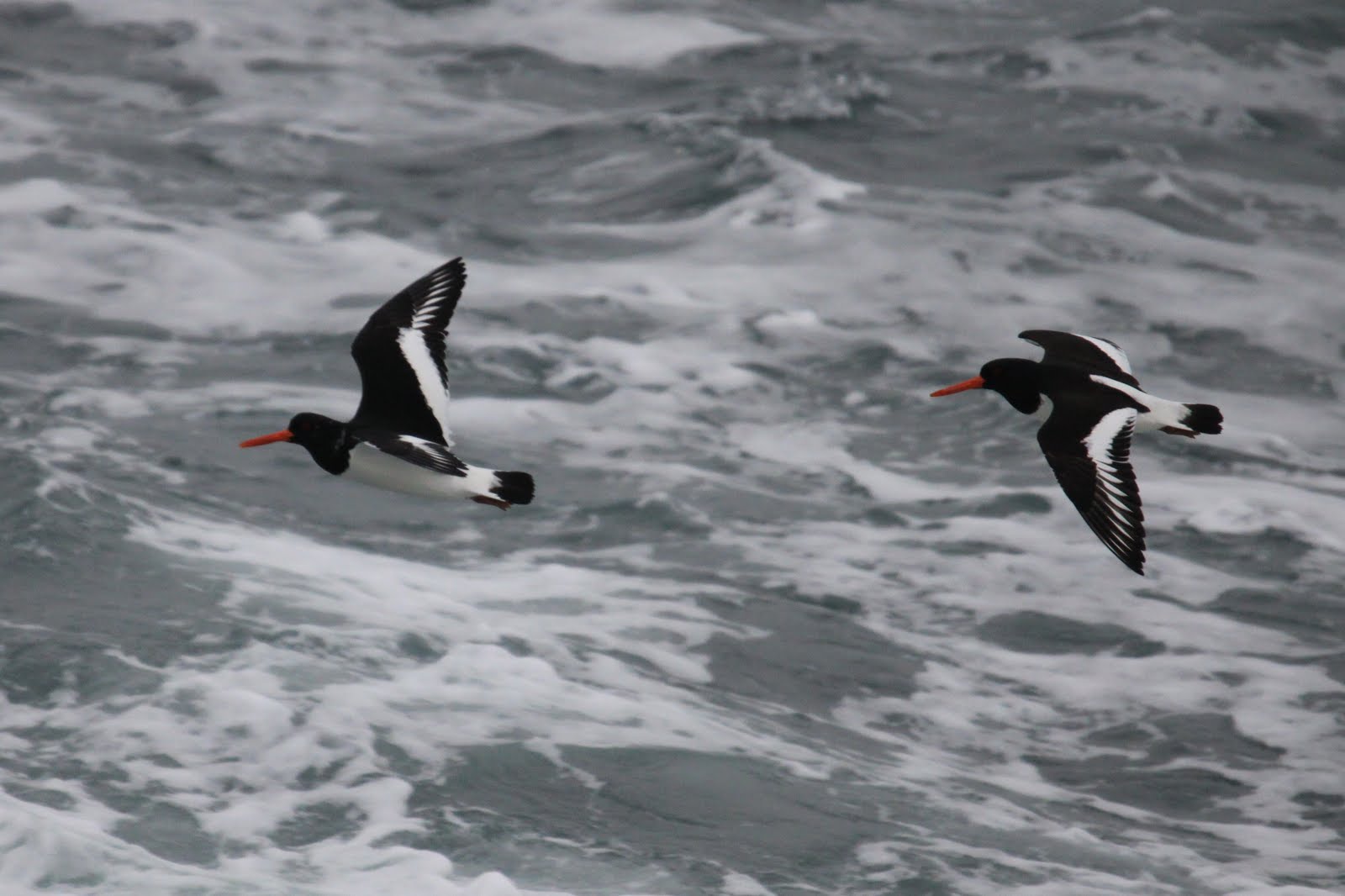
Oystercatchers off the Bill

Kestrel at the Coast Guard Cottages

The Serco Denholm work-boat SB Navigator rounds Portland Bill. SD are the company that took over from the Royal Maritime Auxiliary Service when the service was privatised. I spent a number of years with the RMAS and forerunner the Port Auxiliary Service (PAS) pushing similar vessel about. When I see such vessels, as is often, I am reminded of the last verse of this epic gem penned by John Masefield, a poem which was later put to music. I was privileged to sing this song along with the Bramcote Hills Boys School Choir at the Royal Albert Hall, Nottingham.

Quinquireme of Nineveh from distant Ophir,
Rowing home to haven in sunny Palestine,
With a cargo of ivory, apes and peacocks,
Sandalwood, cedarwood, and sweet white wine.

Stately Spanish galleon coming from the Isthmus,
Dipping through the Tropics by the palm-green shores,
With a cargo of diamonds, emeralds, amethysts,
topazes, cinnamon, and gold moidores.

Dirty British coaster with a salt-caked smoke stack,
Butting through the Channel in the mad March days,
With a cargo of Tyne coal, road-rails, pig-lead,
firewood, iron-ware, and cheap tin trays.

A Roman Quinquireme
Nineveh was an ancient city on the eastern bank of the Tigris River in ancient Assyria. Its ruins are across the river from the modern-day major city of Mosul, in the Ninawa Governorate of Iraq.

Ophir is a port or region mentioned in the Bible, famous for its wealth. King Solomon is supposed to have received a cargo of gold, silver, sandalwood, precious stones, ivory, apes and peacocks from Ophir, every three years.

and the female Blackcap still enjoying the groceries supplied by the Warden at the Obs.

finally, my remiss yesterday was not welcoming Peter Storrs and his wife to the Blog readership. I have seen them around the town on a number of occasions but we were able to talk on the bus at this meeting. Peter informed me that his wife has always wondered where my hat comes from, so I was delighted to tell her Mongolia. Looking forward to seeing you both again soon, hoping for a longer chat.

Friday, 28 January 2011

'Whale Meat ' Again - Vera Lynn

Don't know where, don't know when!

The single most notable element about this morning was the 'cold', and while the ambient temperature was low enough the biting north easterly produced a bitter wind chill. A walk around Radipole, through the town centre, over Town Bridge and Weymouth Quay to the Nothe Fort, a wander along the Stone Pier and around Newton's Cove produced little more than the 'usual suspects'.

Great Black-backed Gull

Herring Gull

and Black-headed Gull all scavenging around the harbour, and

two dozen Turnstones, turning stones on the fore-shore.

At Ferrybridge there was little more than c7 Little & c2 Great Crested Grebe and

a handful of Red-breasted Merganser

this male at least putting on a reasonable 'fly past'.

Not a bad day really for having my perambulations curtailed by a trip to Bristol Airport to pick up my lovely neighbour Joy. However, having watched yet another instalment of the superb BBC television production of 'Human Planet' most of my thoughts harked back to last evenings subject material. The essence of these fine documentaries is the way that 'man' has adapted to the most harsh conditions the world can throw at him, last night focusing inside the Arctic Circle. My first venture into this mainly frozen waste was at the tender aged of 16 years when I was drafted to the type 14 frigate HMS Keppel part of the Fishery Protection Squadron. For a year I plied these northern waters and enjoyed every minute, what mid-teenager wouldn't.

As the years went by, I flew over it many times on various journey taking the 'Great Circle' route to such places as the United States, but perhaps the most unusual of all crossings was submerged at one to two hundred feet on HM Submarine Alcide in 1968. Each and every one of these trips were both exciting and mind boggling, but none more so than a visit to Barrow, Alaska in 2007.

Last nights programme featured the Greenland Inuit, while in the most northerly city in the USA we visited the Alaskan Inuit. Along with Susan Hallam , we had travelled the full length of the Alaska highway, having started our journey in Los Angeles and arriving at Fairbanks had to take a flight to Barrow as the road (if that;s what it could be called) was still frozen even in June.

The Captain announced as we 'crossed the line', at which point I took this photograph of a mainly mountainous terrain.

Only a few minutes later, the whole scene had changed to ice floes with some open water.

Our welcome could not have been more convivial, as even before leaving the aircraft an Eskimo (don't let the PC brigade deter you from using this description or the term Indian as my own extensive research has shown that the indigenous population have no problem with this at all) lady had already invited us to her house.

We walked from the airport, through the town centre to

our hotel which, had it not been frozen solid right up to the North Pole, would have been beside the sea. Even before checking in, we were again befriended by 2 young men conducting an ornithological survey on behalf of the US government who were at pains to drive us on their quad bike to see a summer plumage Red-necked Stint (see photo below).

On day 2 we met the most famous man in town at that time, 'Forest the Bowhead Slayer' seen here with Sue. Having hunted the Bowhead Whale for 5 years, thus far he had never returned empty handed. It may be of note that in Greenland the prime target is the Narwhal, in both cases hunted legally and in the traditional manner.

These small boats are the only protection these brave hunters have from their might catch, and spend most of their time on the frozen sea. If the boat has a flag at the mast, this denotes success in the previous seasons hunt.

The Whale Festival starts as the collective crews drag the most successful boat from the ice and place it central to the celebrations, as

ALL the towns people gather around a table weighed down by bowls full on piping hot White-fronted Goose stew - no one goes unfed, yum, yum! After the stew comes the highlight of the day and the most prized part of the whole catch. Once the Whale is landed most of the carcass is butchered and shared out among the population, All that is except for the select part of the epidermis, which is cut into strips and marinaded in whale blood for 6 months. Every morning and evening the meat is ceremonially stirred, the final product being

Muktuk 'the' delicacy to the Eskimo.

Never being one to shy away from a new experience, especially gastronomic, I braved the Muktuk, but
as can be seen in these photos, much to the delight of the local populous,

my demeanor changed with every mouthful.

The Greenland's also do a delicacy of Little Auk marinaded in their own feathers within an airtight seal skin. Unfortunately I have never tried this but having eaten Puffin, maybe that counts?

and finally just a few of the host of wonderful birds we encountered.

Dunlin, certainly a different plumage to which we're used to!

Lapland Bunting

Long-tailed Duck

Red-necked Stint

Snow Bunting (male)

Snow Bunting (female)

Grey Phalarope

Red-necked Phalarope

The Magnificent

Snowy Owl

Snowy Owl nest

Thursday, 27 January 2011

Da Doo Ron Ron - The Crystals

Yet another country to add to the readership today, by way of Yemen. I visited the country under less than favourable conditions in 1966 but feel so pleased to welcome you to the Blog. As ever I would ask you to pass on the link to your friends and family.

A day 'birding' beyond the county boundary today as I headed for Hampshire under a leaden sky but otherwise set fair for a good day. Arriving at the small hamlet of Hook, nestled on the edge of the Solent (the stretch of sea that separates the Isle of Wight from the mainland), I was just a short distance from my first target bird of the day.

From here the Fawley Oil Refinery was clearly visible

with its landmark chimney on the skyline.

In the distance No Mans Land Fort could be seen, one of the 4 Palmerston Forts built in the 1800's to protect Portsmouth, the others are Spit Bank, Horse Sand and St Helen's.

The wind was piping along the cliff line, but there was a conveniently placed wartime pill box which I used to search the foreshore for

a Red-breasted Goose that had been here for a few days.

The tide was about as low as it could be, with little chance of seeing the Goose, which was feeding with dozens of Brent Geese at the low water mark, at close quarters.

However, the Brents seemed to be continually attacking the Red-breast

eventually putting it to flight,

and sending it a little close to where I stood. From here I headed for the New Forest, and in the first instance to Fritham.

Here, the Royal Oak stands as a fine example of a Forest Public House. At

it took quite some time to find the resident

Mandarin Ducks and even then there were only

2 boys and

a single girl.

On the way back it looked like a couple of New Forest Donkeys were waiting for 'opening time',

and what was once the elegance of Fritham Manor

is now a Nursing Home. A number of Thrushes can be seen feeding on the grass verge,

and here they are a little closer up, a Mistle Thrush and a

Redwing. So far this year the best bird I have seen is the White-tailed Sea Eagle at Downton, but today's find will probably go down as the luckiest! Quite close to the village is an excellent 'Raptor' (Bird of Prey) watch-point which I felt well worth a look being so close.The road was under repair, but there was access to where I wanted to go, but miscalculating the site I parked some distance away. Deciding to walk anyway, I cut through a small stand of Holly Saplings 'flushing' an Owl in the process. Of the 6 or 7 times I saw it only once was it perched but this gave me the chance to positively identify it. It was a Long-eared Owl - an excellent find. Continuing through the Forest to Ibsley Bridge, 13 of the reported 15

Bewick's Swans were easily located but

remained at quite a distance.

Of the 13 seen, one was a juvenile but stayed even more distant and

partially obscured by a tree.

In searching for a Great White Egret (but not found) this house looked of interest, maybe especially to our overseas readers, as an example of a typical English cottage.

Along the way was a field full of Mute Swans, but it was now time to turn my attentions to the Blashford Lakes Nature Reserve.

Plenty of birds here, as usual, including these Siskins

a couple of males

and a female,

and yes Sheila, sorry to drop this on you in such a way, but look who I found in the hide! Ron 'Chunky' King has to be one of the longest standing 'birders' in Great Britain and his country list certainly matches this. GREAT to see you today my mate, next stop the Portland Obs?

Collared Doves were taking advantage of the feeding stations, as

were a good number of Brambling -

altogether a great day!

and finally, I found this video clip most amusing. I am probably the least PC (Politically Correct) person in the world so I would.

http://www.youtube.com/watch?v=jWFq-v7TKdQ