This photograph, one of 3 reproduced on yesterday's Blog, was of the Portland Search & Rescue helicopter carrying out what I considered to be an authentic rescue rather than an exercise? Today I received this e-Mail from friend and fellow birder Nick Stantiford
* To: captbagsy@waitrose.com
* Date: Wed, 4 May 2011 09:59:18 +0100
* Subject: Yesterday's Blog - aka 'You don't miss a thing do you'
Hi Paul
The vessel being attended by the SAR chopper in your pictures was my son Lyle’s charter boat Supanova which, despite the weather, was safely en route to Guernsey for a few days Turbot fishing with 5 hard core anglers on board, including yours truly.
The 'object' winched from the deck was some 58 year old angler come birder who was suffering from a vasovagal syncope (that's doctor speak for a fainting attack apparently) and as a result I am now sitting at home taking things easy! Bloody typical, I've been doing this sort of trip for years without problems and this one was going to be very special as the first Channel Islands expedition on Lyle’s new boat but now I shall have to be content with meeting the boat when they get back on Friday night and being taunted with tails of huge flat fish, much eating of good food and drinking of fine wine!
Catch you soon
Nick
The vessel being attended by the SAR chopper in your pictures was my son Lyle’s charter boat Supanova which, despite the weather, was safely en route to Guernsey for a few days Turbot fishing with 5 hard core anglers on board, including yours truly.
The 'object' winched from the deck was some 58 year old angler come birder who was suffering from a vasovagal syncope (that's doctor speak for a fainting attack apparently) and as a result I am now sitting at home taking things easy! Bloody typical, I've been doing this sort of trip for years without problems and this one was going to be very special as the first Channel Islands expedition on Lyle’s new boat but now I shall have to be content with meeting the boat when they get back on Friday night and being taunted with tails of huge flat fish, much eating of good food and drinking of fine wine!
Catch you soon
Nick
 Oh! Just couldn't resist another shot, so here's Nick being winched from the mighty 'Supanova' while the rest of the lads continue their voyage to enjoy themselves - TIGHT LINES!
On a really serious note, I do hope all is well with you Nick and your fully well again.
Probably the strangest occurrence of the day is that for the very first time I didn't take one photograph, consequently all images today are taken from the archive for illustration purposes only.
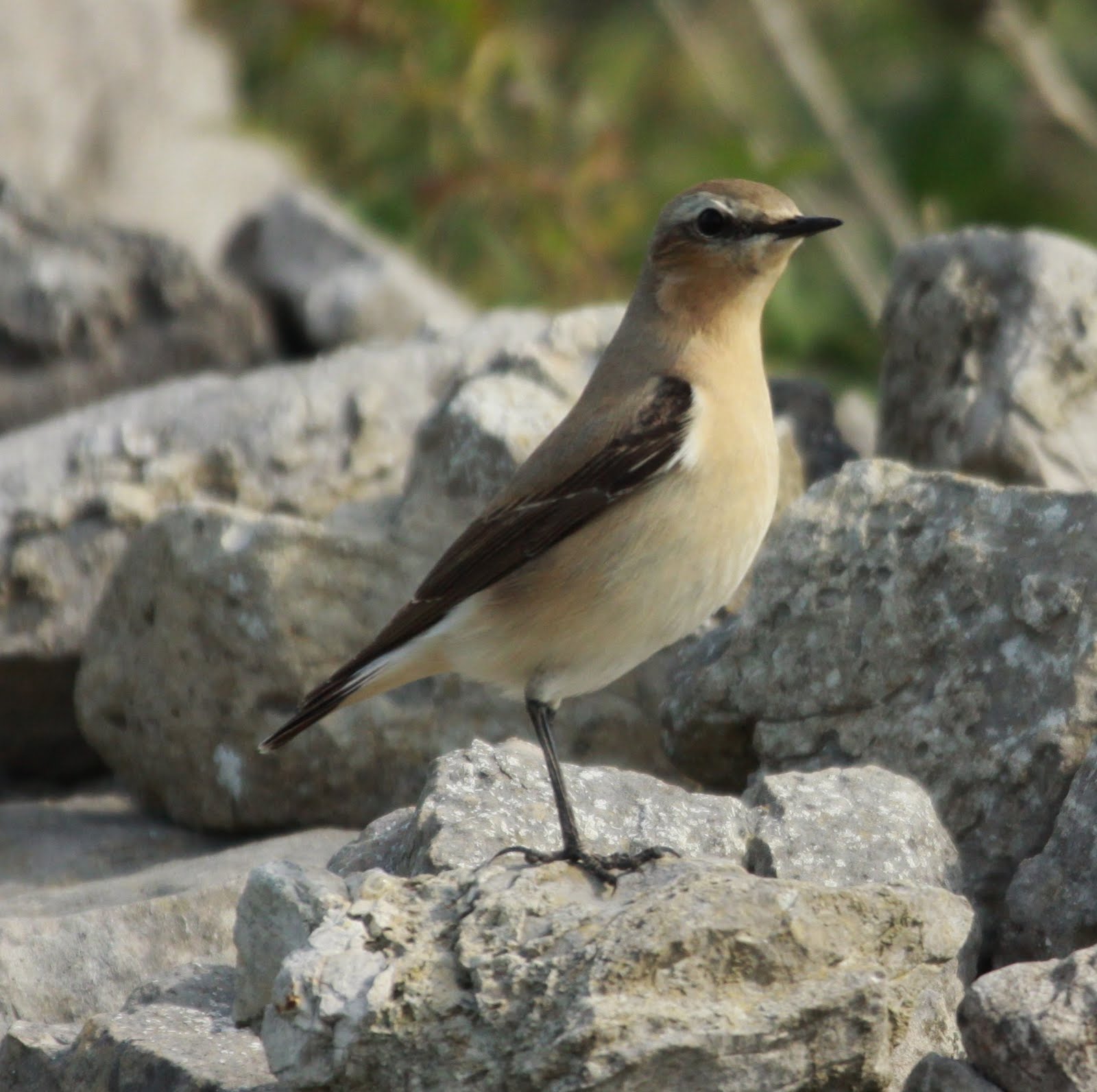
Considering Portland to be a good bet for an early visit, particularly a look at what might be passing to seaward, I forsook the local patches and paid for my bus fare, agghhaaaa!, intending to make quick passage to the coast. However, the sight of a light sandy coloured bird on the main path across the Top Fields had me stopping in my tracks, but not quickly enough to see it raise its head and fly off into the adjacent field. During the brief few seconds it was in view I could see it was a Pipit (albeit rather Wagtail like) with uniform light buff plumage, with no distinguishing markings at all. While on the ground it showed an elegant upright stance but this may well have been its reaction to my approach. I looked into the field, which holds a crop of high growing plants, but has a narrow furrow running down its length, where I saw the bird just briefly again. It is a full one minute walk to access the field via a kissing gate, which I did but after a 15 minute search and an attempt to phone the Observatory, it was not seen again.
Considering Portland to be a good bet for an early visit, particularly a look at what might be passing to seaward, I forsook the local patches and paid for my bus fare, agghhaaaa!, intending to make quick passage to the coast. However, the sight of a light sandy coloured bird on the main path across the Top Fields had me stopping in my tracks, but not quickly enough to see it raise its head and fly off into the adjacent field. During the brief few seconds it was in view I could see it was a Pipit (albeit rather Wagtail like) with uniform light buff plumage, with no distinguishing markings at all. While on the ground it showed an elegant upright stance but this may well have been its reaction to my approach. I looked into the field, which holds a crop of high growing plants, but has a narrow furrow running down its length, where I saw the bird just briefly again. It is a full one minute walk to access the field via a kissing gate, which I did but after a 15 minute search and an attempt to phone the Observatory, it was not seen again.
 I have no doubt that this was a Tawny Pipit, likely an adult, but with such scant description doubt it will convince others, luckily I only have to satisfy myself. Making best haste for the Obs, Martin Cade, John Lucas and John Down returned with me to the location but after covering a lot of ground we gave up the search.
With reports coming from the 'sea-watchers' of numerous seabirds, it was time to head for the Bill where John Down and I met up with probably as many as 20 other observers. Terns and Auks were in good numbers and among them were a few Kittiwake, Gannet, Common Scoter and a single Puffin as the first of 2 (maybe 3)
 Roseate Terns put in an appearance, another 'year tick'. With my new Opticron 'Mighty Midget' telescope perched on a rock and me perched on another I was afforded good views of these dainty and brilliant white little birds. This was rapidly turning into the most extended 'sea-watch' I have done at the Bill for a decade and having already had my second cheese and red pepper roll nick by John (said I'd get you) it was time to leave, but not before watching 2 Black-throated Diver fly over quiet close to shore. These also enter the records as the first of this species to be seen in Dorset this year.
 Having enjoyed a coffee at the Obs, the R/T crackled into life with another report from the Bill of a Black Tern having joined the 'feeding frenzy close off-shore. This was spur enough to get me heading from whence I had just returned, only to find the answer to my question "is it still there" being answered by a report of a Balearic Shearwater flying directly towards us.
 Picking it up fairly quickly in the 'scope, how 'jammy' can you be to see the Black Tern fly into the same field of view? Two further 'year birds' was satisfactory to say the least, and on the way back did try again to re-locate the Pipit but without success. There were no birds, let alone Waders at Ferrybridge, so after a very brief visit to the supermarket agghhrrrrr, it was home!
While flicking through the photo files, it was thought a few more shots of my last trip along the Alaska Highway may wet the readership's taste buds prior to my departure on the first day of June for a re-visit. All of these shots were taken close to or at Toad River, in mid-June 2008.
 American Bison
 Caribou
 Stone Mountain Sheep
 Yukon View close to Toad River
 'The Summit' highest point on the Alcan Highway
 Susan Hallam & I enjoying a mid-June 'white-out'.