Tuesday, 12 July 2011

Day Two on St Paul, Pribilof Islands, Bering Sea

We start today's post by welcoming yet another country / region to the readership, this time at number 146 American Samoa join us. In with a real 'bang' they start with 25 readers who we hope will spread the word and pass the link on to all families and friends. Great to have you onboard and hope you continue to enjoy the read!

It hasn't taken me long to fall in love with the Pribilof's for their remoteness, wildness and the warm welcome from everyone encountered thus far. Strangely reminiscent of both the Buchan Alpha Oil Platform and the Mountain Steppe of Mongolia, firstly

the accommodation is so very similar on the interior (except there are no en-suite facilities here)

while the messing (galley & dining room) is almost identical. Crewed completely by Filipinos, I get such a warm welcome each time I attend and the food is beyond approach. This second dinner time I had prime rib beef steak with Halibut, caught less than a day ago, and on an 'eat as much as you like' basis.

As far as The Steppe is concerned, here nearly all of the open space is covered with a course grass and peppered with an array of Wild Flowers I couldn't even begin to recognise except for the most prolific which is Wild Lupin.

The 'City' is tiny, and as the board indicates supports very few people

while Russian Orthodox dominates as the main religion. There is no shortage of work with fishing, fish processing, mechanical maintenance and the airport providing most of the opportunity.

A typical residential street in St Paul.

The local cemetery, again Russian Orthodox

as is the monument at Big Lake.

Another Aleut Bara Bara dating from at least 300 years ago, when all such houses were constructed of
Whalebone and Seal Skin but have long since fallen to the Tundra.

History seems to have been unkind to the Islands as during the Second World War US troops were sent to raise anything that might be of use to a suspected Japanese invasion to the ground, while prior to that labour for the Seal Trade consisted mostly of 'slaves'! The Islands have suffered more than one Tsunami and a couple of severe earthquakes in more recent time, but things do seem very stable now.

The Northern Fur Seal Watch Towers on the east coast, used to monitor populations.

Arctic Poppy
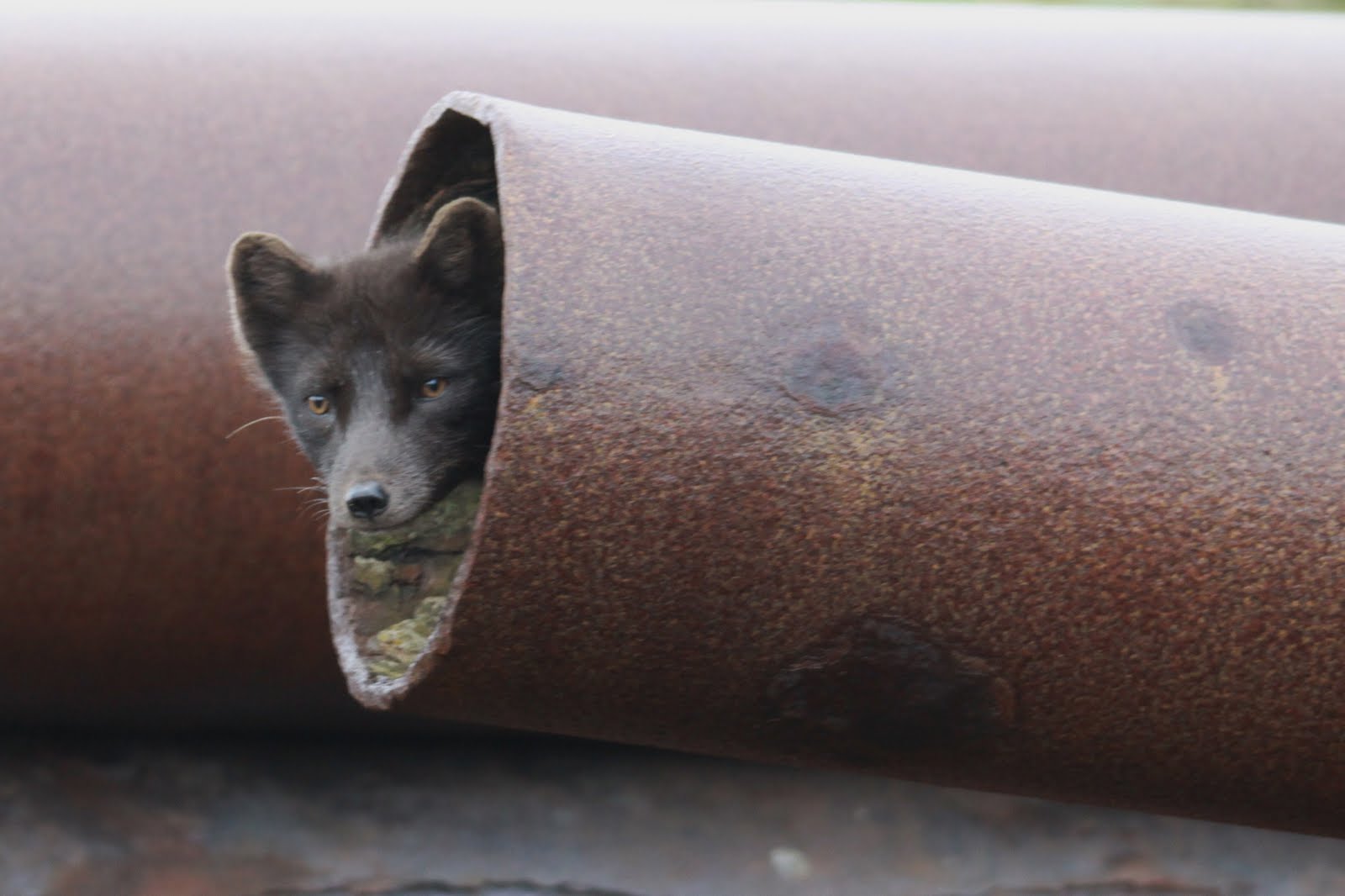
Arctic Fox

Long-tailed Skua

Looking through local records, it was found that the highest day count on the Island for this 'sleek' seabird was until today just 6. This morning alone we counted 43, one of which is presumed to be a 'dark phase' individual. A bird on which myths and legends have been formed, we are making no hard and fast claims, but photographs have been sent to Paul Lehman (an authority on the Birds of the Bering Sea) who, we understand, has shown great interest and in turn has consulted others of his group. It is hoped to publish these photos tomorrow.

All a little nervous to human approach but what a bird to see even at a distance (which most usually do).

Harlequin Ducks heading to the shore, and

hauling out.

Siberian Eider (female) this crippled bird has remained since the early Spring.

Pink bill and rufous plumage.

In the interior at the grave of

James Heath of the USS Concord, haven't had time to investigate him yet, but bet I know a man who will!

Snow Bunting (male)

Snow Bunting (female)

Snow Bunting (juveniles) in varying stages of development.


A couple more shots of the Long-tailed Jaegers

The only 2 Arctic (Hoary) Redpoll we have come across so far.

Grey-crowned Rosy-Finch considered worth publishing 'every day'. Fantastic!

We had some fantastic company at dinner this evening, as some of the crew of the 'longliner' Northern Prince docked to off-load her cargo of 40,000 pounds (weight) of prime Bering Sea Halibut.

It was agreed that the meeting was all too short as 'she' was sailing within the next hour,

'wash-deck lockers' crammed full with 'long-lines', hooks freshly sharpened

she pulled through the harbour entrance for another couple of weeks looking for more Halibut and Black Cod. Hope you lads do read this when you get back to Washington State at the end of September and drop me an E-Mail please!

Monday, 11 July 2011

Day One on St Paul, Pribilof Islands, Bering Sea

Seems we have gathered another ardent reader on the way, as I met Aaron Bowman on the coastal path in Anchorage last week while searching for Hudsonian Godwit. A fellow birder, he gave me a few tips on where best to photograph them along with other advice, but when his wife arrived and started to whistle him from afar he didn't recognise the 'call'. I feel sure she will have forgiven him by now? However, Aaron has pointed out a couple of identification mistakes firstly with one of the 'claimed' Fox Sparrows at Seaward which he tells me is the often confused North Western Song Sparrow. In addition the so called Cedar Waxwing at Denali is in fact Bohemian, both of which will be corrected in the narrative soonest. Thanks Aaron and please keep in touch.

A map of south west Alaska, and the Pribilof Islands including St Paul where I am right now.

There is always a serious threat of fog preventing flights to the Pribilof's, today being no exception except to say that St Paul was 'land-able' while St George was shrouded. We took off right on time 12 noon and made one stop at Dillingham, mainland Alaska, for fuel and in so doing saw Beluga Whales for the very first time. I had also encountered a group of independent Swiss birders who were heading for the Island of Fog and it would be good to think they reached there after we were dropped at St Paul. Good luck Phillipe & Co.

Overflying the south western tip of Alaska before heading out into the Bering Sea.

The turbo-prop Saab aircraft that carried us here.

Alighting the plane, and before leaving the tarmac, the first bird was sighted a Grey-crowned Rosy-Finch, of the altogether larger Pribilof sub-species, and a World Lifer to get the ball rolling.

In the airport I recovered my bag and took a look around for my fellow birders, but everyone seemed to have left.

It was then Forrest Rowland & Michelle Carton introduced themselves and told me I was the only one on the tour - YES! Forrest, not only a well travelled birder and member of the Ecuador Rarities Committee but also a mutual friend of Byron Palacios (also from Ecuador but now living in Dorchester) would be best described to those who know them as a cross between Paul Harris & Dave Chown. It would be difficult to find better! Michelle, a school teacher back on the mainland and married to a local halibut fisherman, is not only an accomplished local historian and general naturalist but is also currently under Forrest's wing training to be a 'birding guide'.

Shown my room which is part of the airport building and similar to a hostel is well appointed, clean and comfortably warm. Next port of call was the 'Bulk Store' which only sells beer and wine (no hard liquor) and then straight on to the job in hand.

"Did I want to wait and savour the anticipation of a Red-legged Kittiwake, or did I want to go straight for it" was my guides first question, and the picture above answers that question as 10 minutes later I was recording my second to last species of Gull in the World. It was distant, and there was a promise of more so we headed for the coast and an introduction in orientation.

There sheerlegs were used to part salvage

this wreck of a small oil tanker

but the cash ran out and there it has lain for many a year.

Next I was shown this circular depression in the ground, now overgrown, which about 300 year ago was a 'Bara Bara' a house built of Whalebone supports and covered in seal skin and lived in by the then residents of the island the Aluet (Unangan) Eskimos.

The next Red-legged Kittiwake wasn't long in coming as we found this single 'second summer' bird

with a group of Black-legged Kittiwakes.

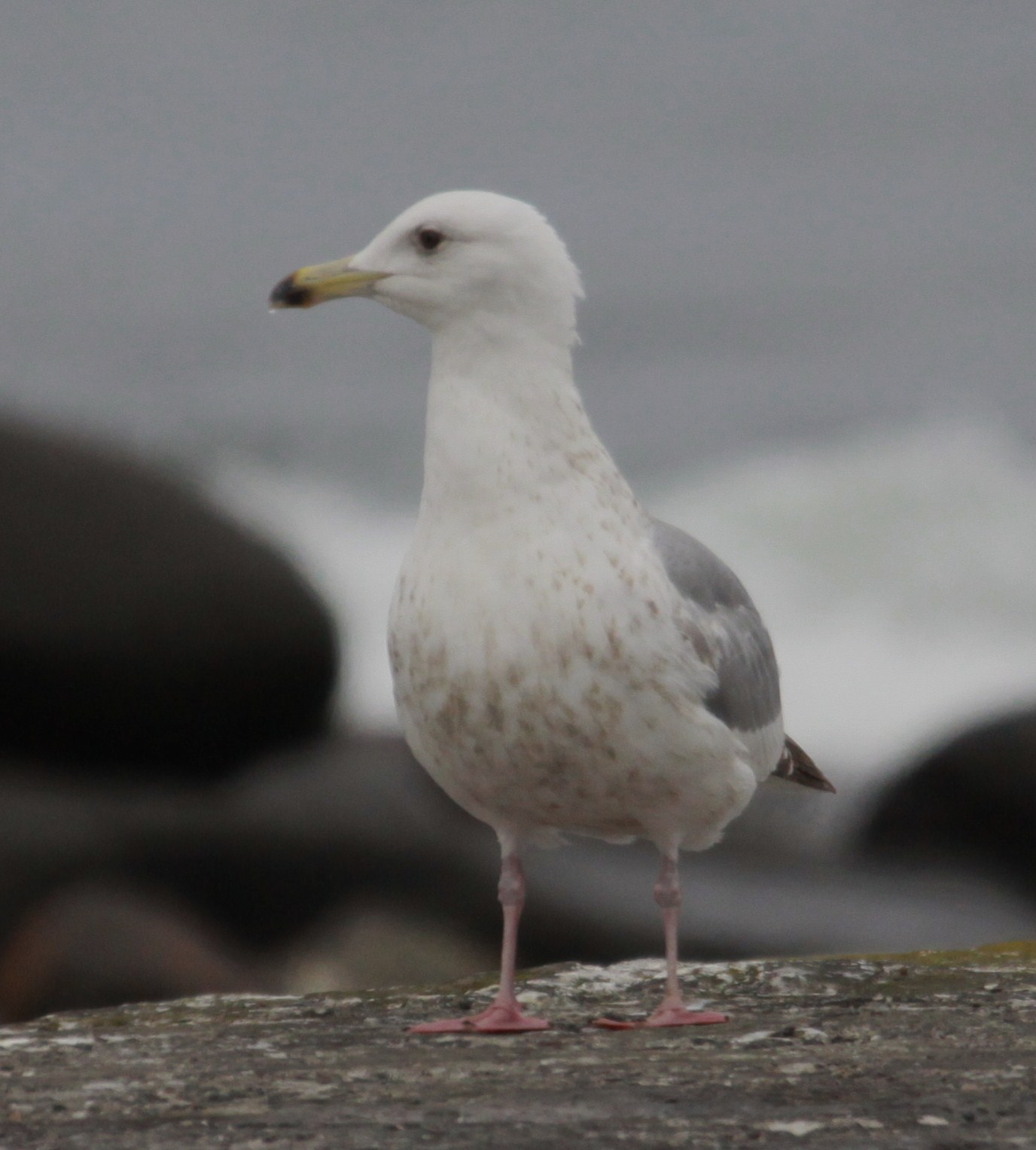
An uncommon find, in the same area, was this sub-adult Herring Gull sub-species

Vega Gull

Black-legged Kittiwake

The next World Lifer flew in from seaward in flock form, as these

Least Auklets landed close by.

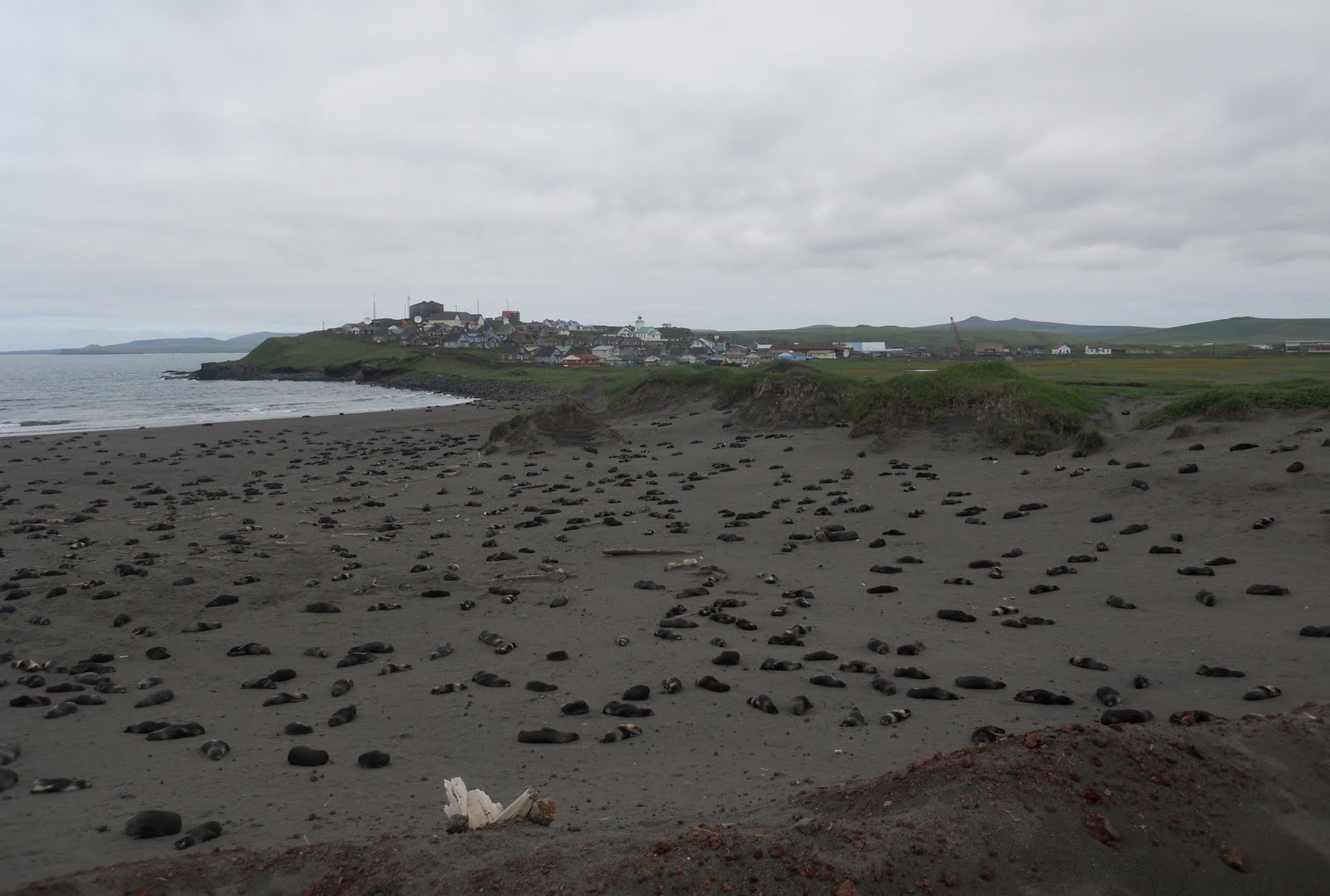
This colony of Northern Fur Seals is closes to what is referred to as the 'City of St Paul' which can be seen in the background.

Northern Fur Seals.

Parakeet Auklet, already seen at Seward was next

followed by this Capitate Velerian which was by no means the end of the days birding, but as we were out until close to 23-00 there has not been time to edit most of the photographs, some of which I hope to be able to publish tomorrow?