 Believing there is usually more than one way to 'skin a cat', even though we did not see yesterday's star turn we know a man (or two) that did. With kind permission of Ian Dodd, seen here photographing the Paddyfield Warbler, and Martin Cade we can bring these images of
 this extremely rare bird to a wider audience. More or less confined to the Continent of Asia, this is the first time on record
 that one has graced Dorset.
After only a few short paces this morning it was soon apparent that it was going to be a day full of bird, with many dozens of Common Swift and House Martin flying high over Westham and no fewer than 23 Blackbirds counted in the cemetery during the first 10 minutes.
 Just 2 of the 5 Collared Doves seen there, but I have been unable to locate any of the Goldcrests that are singing to confirm breeding. Over the road at Radipole Lake one or 2 Reed Warblers were still singing, a few Sand Martins where showing as 2 Greenshank flew over the reed-beds at quite close quarters.
 This single Grey Heron was patiently waiting for prey as 2 Marsh Harriers took to the air close to North Hide but too distant for the camera.
 Hunting adult Common Terns have been a feature here every day since my return,
 but today they had been joined by these 2 juveniles, most likely from the Lodmoor colony, saving Mum & Dad the flight back each time.
 They were certainly making plenty of noise about it, and taking to the wing each time a parent bird approached with food.
 This adult Lesser Black-backed Gull on the car park was too much of a temptation, as were a
 couple of young Great Created Grebes, this one spending some time trying to catch insects.
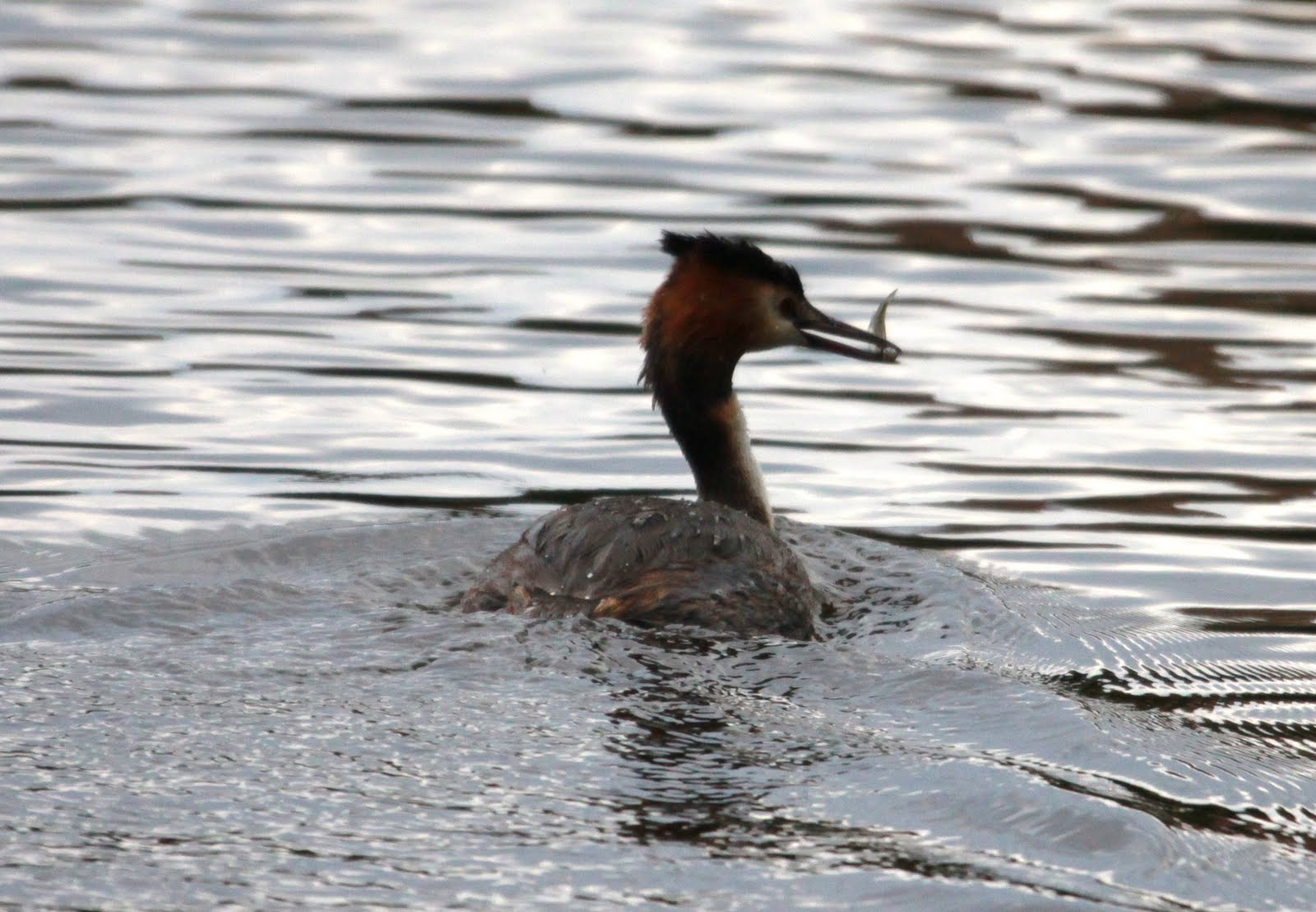 Something slightly more substantial was on offer via a parent bird
 tempting the juvenile to quit its Flycatching. Once again deciding to PAY on the bus to Portland, I decided half way not to go the full distance to Avalanche but alight at Barleycrates, a full 10 pence cheaper but the driver wasn't doing any discounts.
 The first bird encountered, a Warbler, looked at a distance to have a 'crown stripe' which was of great interest
 but I was unable to close the distance on it and proved to be a Sedge Warbler anyway, so panic over.
 There followed a series of shots of Grasshoppers, this one firmly clamped in the bill of a Meadow Pipit
 while the next had fallen to this most approachable
 Skylark. There were also 2 Willow Warblers along this section of path and a probably Garden Warbler that simply wasn't seen well enough to claim.
 This Stonechat hadn't managed to catch one yet, and continuing along the West Cliff
 neither had this Great Tit
 nor the 7
 Whitethroats, in company with 4 Chiffchaff, around the rotting hay bales at the end of what used to be the Admiralty fence.
 Down at the existing Admiralty compound the Stonechats seemed to be having far more success with both male and
 female appearing to have Grasshoppers. It may be of interest that the cliffs are devoid of seabirds, and except for a 'calling' Dunlin, flying south, there was nothing of note seen from the Obelisk.
 There was however something most worthy of note as I neared the Bird Observatory, my old Shipmate Barry Sellen and wife Annette recently returned for their second home in France and making ready for the Summer Holiday with their family 'out the Bill'. Great to see you both!
 At the Observatory there had been a decent overnight catch in the Moth traps, most notably this 'Fine Pair' (as Pink Floyd would say) of rare Bedstraw Hawk-moths.
 In addition there was a fly-over Yellow Wagtail which alerted us by 'calling', but this photograph comes from the archive and is dated May this year.


