Best to correct all the errors and
typos on yesterday's post, starting with the most amusing. The Peasant
wasn't 'cooked' at all, the caption was suppose to read Silver BACKED
not 'BAKED' (however, should it stray within range of the air-rifle I'll
let you know)! The Broad-bodied Chaser is in fact BLACK-TAILED SKIMMER,
the Wild Mint is more likely MARSH WOUNDWORT (although not totally
certain) and LARGE RED DAMSELFLY fits the un-captioned Insect. Thanks to
Steve Smith, John Gifford et al.

The Electric Dustbin has been repositioned once again,
this time between a row of WELLINGTONIA

and an ELM HEDGE along with a number of garden ornamental,
more to come but the day didn't start at all well.
more to come but the day didn't start at all well.

Firstly, a moribund (died later)
GREENFINCH
was found close to one of the many bird feeding stations,

followed by a dead TOAD on the front lawn,
after which everything else was 'living'.
The move proved quite successful with a number of new additions
to the Property Moth List*.


ELEPHANT HAWK-MOTH

THE RUSTIC*

COMMON RUSTIC* (female)

COMMON RUSTIC* (male)


DARK SWORD-GRASS*

MOTTLED RUSTIC*

MICRO

EARLY THORN*

CLOUDED SILVER

At the bottom of the trap was this most interesting find,
which had me scurrying off to consult Wikipedia.

The insect was familiar, BURYING BEETLE, the first was caught
just a few days ago. Initial thought was 'paracites', but later
considered the possibility of 'young'.

They are in fact
PHORETIC MITES
which do no harm to the Beetle in fact each serve a
function for the other.
PHORETIC MITES
which do no harm to the Beetle in fact each serve a
function for the other.

WHITE-PLUME MOTH

 GOLDFINCH on front garden feeder.
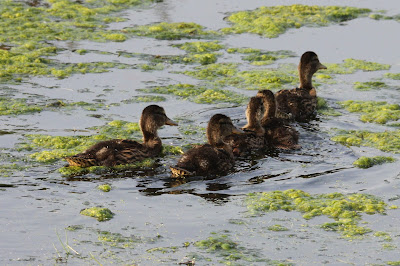
 Juvenile COOT on Parley Pond.
 Unfortunately, this COMMON KESTREL had positioned itself
 so it could only be photographed through a closed window.

 NUTHATCH (archive photo)
Watching
the surviving c4 of c6 this morning they proved to be behaving more
like Little Grebe than Coot. While not considered a 'diving' bird they
do forage for food during short dives, but these youngsters were acting
differently. At my approach they took refuge under the Pond Weed where
they stayed, on occasion, for a full minute interesting! They got
accustomed to my presence in fairly quick time. While in the back garden
there was good reason for any small bird to hide.
One
of 2 pairs breeding close by, along with the local Sparrowhawks reek
havoc with the small birds at the feeding stations. Despite the
prolonged view the identity of the 'prey species' on this occasion was
not determined. The 'birding' highlight came a little later in the day,
in fact just as the Second Test was about to continue. The 'chattering'
of a
was
heard from the west end of the garden which continued, off and on, for
about 30 minutes. Although they are occasionally recorded in the far
more wooded areas at the north end of the farm, some 1.5 miles away,
this is the FIRST anyone can recall from this location so close to the
house. Unfortunately the bird was not seen but a 'peanut feeder' was
immediately dispatched to the site between the only two trees an Alder
and Ash.
| Entry | Pageviews |
|---|---|
United Kingdom
|
926
|
United States
|
288
|
Russia
|
110
|
Germany
|
39
|
Estonia
|
30
|
France
|
17
|
Saudi Arabia
|
17
|
Canada
|
14
|
Ukraine
|
13
|
South Korea
|
12
|