Thursday, 25 July 2013

Maggie's Farm - Bob Dylan

Amid cooling temperature and sporadic light rain last nights catch was much reduced, but fear not there were a couple of additions* to the Property Moth List
NUT-TREE TUSSOCK*
THE FAN-FOOT*
After monitoring the trap, much of the day was spent just wandering
around the farm see what could be found.
The various ponds around the property hold SCARCE CHASER L. fulva is scarce in Britain and is consequently listed under category 3 (scarce) in the British Red Data Book on Insects. The Scarce Chaser is restricted to 6 main localities in Norfolk/Suffolk, Sussex, Wiltshire/Somerset, Cambridgeshire, Kent and Dorset/Hampshire. Populations appear to be stable and there is evidence that suggests that it may be expanding its range. This was a late ammendment on information from those who put me right from time to time.

AZURE DAMSELFLIES
GREAT BURDOCK
with BRIMSTONE BUTTERFLY
COMMA BUTTERFLY
juvenile ROBIN
one of 'many dozen' hereabouts.
SIX-SPOT BURNET MOTH
A 'Blast From the Past' this
Hawker Siddeley TRIDENT Airliner
has been visiting Bournemouth International Airport
with some regularity today.
WATER LILY
LARGE SKIPPER BUTTERFLY
LONG-HORN BEETLE
PICKEREL WEED
an invasive water-side plant originally from the Americas
 PURPLE LOOSESTRIFE
WHITE-TAILED BUMBLE BEE
It was thought that this period (Summer) would, as ever, be quiet on the wildlife front but it seems to have been far from that. To help free up a little more time for me, I have asked my friends Sheila Edwards, John Gifford and Paul Harris to assist in some of the identifications associated with the Blog. Rather than post a 'credit' with every image it is simpler just to issue my blanket THANKS to each of them now!
and finally, we end on a sad note.
Long Association with Weymouth - Then Tragedy

Wednesday, 24 July 2013

More Moths and Birds

The spot around the Wellingtonia's continues to be productive Moth-wise, but there was some concern as inclement weather visited us overnight heralded by high winds which brought with it heavy rain. In addition, looking from the bedroom window at 02:00, thinking the trap should be turned off, there was the most violent of thunder-storms accompanied by a spectacular display of lightning.
Just look what the weather dragged in!
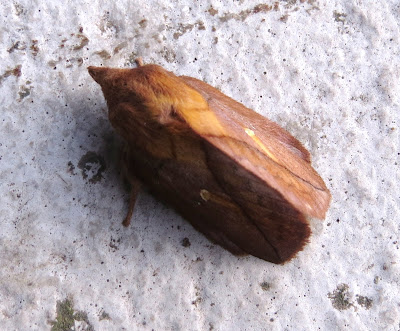
DRINKER
 A common Moth that always reminds me of a Mole.
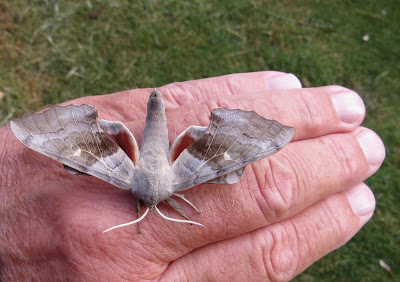
POPLAR HAWK-MOTH
 RIBAND WAVE
 PURPLE THORN*
 BUFF-TIP x 4
CREAM-BORDERED GREEN PEA
 BROWN-TAIL*
Certainly one of our most destructive Moths/ Insects.
Some additional reading is available via the Link below.
Brown-tail
DINGY FOOTMAN* (right) with x 2 COMMON FOOTMAN
LESSER BROAD-BORDERED YELLOW UNDERWING*
Another sunny and hot day followed.
STARLING
SWALLOW
COOT
PLUME MOTH Sp
ROBIN 'helping' to empty the Moth Trap.
Entry          Pageviews
United Kingdom
               918
United States
               300
Russia
               103
Germany
                 33
Estonia
                 33
Canada
                 20
France
                 17
Saudi Arabia
                 17
South Korea
                 14
China
                 10   

Tuesday, 23 July 2013

Then There Were Three - Genesis

Last evening was thought to have been the thirteenth BBQ during this lovely period of fine weather. Along with this distended
COURGETTE (almost a Marrow) 
stuffed with grilled bacon, rice, onion, capsicum and a sprinkling of cheese, we also enjoyed venison sausage, pork ribs, shish kebabs and garden vegetables along with a decent red Côtes-du-Rhône-Villages. The predicted and expected overnight rain and thunder didn't materialise, but as a precaution the Moth Trap had been re-sited under the bedroom veranda.
 Preparing it for examination, this
 GREY HERON,
 very common hereabouts, unusually flew in and perched in a tree-top.
 While numbers of Insects in the trap were much reduced, this was
replaced by quality in the shape of
THREE CRACKERS
 (putative, but almost certain) EAR MOTH*
BIRD'S WING* (right) with DARK ARCHES
BIRD'S WING*
likely qualifies as the 'rarest' Moth we have caught to date.
'Clancy' describes the distribution as "virtually absent from Southern and Western Wales, South West England (where we are) and North and South Yorkshire".
CLOAKED MINOR*
This also remains unconfirmed but if the ID is correct then it is 'abberant' (deviating from what is normal; untrue to type), which shouldn't have the whole base of the wings dark like this. This remains in the hands of Paul Harris for further investigation.
KNOT GRASS*
 PEBBLE HOOK-TIP
 COMMON CARPET
 CLOUDED BORDER
BUFF ERMINE
BURNISHED BRASS
Another 'Micro' I can put a 'handle' to
BIRD-CHERRY ERMINE
other creatures in the trap included
LACEWING Sp
 and this CADDISFLY, with particularly long antennae,
which we catch with some regularity.
It is thought to be of the genus Mystacides?
Another particularly welcome House Guest
PEACOCK BUTTERFLY
which, as with all other Insects, was quickly released unharmed to the wild.